Oct 28, 2026
AI Onboarding Workflows That Cut Time-to-Value for SaaS
For a SaaS product, the gap between sign-up and first real value is where growth is won or lost. That gap has a name: time-to-value. If a user reaches a useful outcome quickly, they activate and stay. If the product hands them a blank screen and a setup checklist, most drift away before they ever see what it does, and that early churn is almost invisible because it happens before anyone counts them as a customer.
Onboarding is where that clock runs. The old answer was a product tour and a help-doc library, which still leaves the real work of setup on the user. The better answer is to let AI do that work. The seven workflows below each attack a specific place where onboarding stalls, and together they turn a manual setup into a guided path to value.
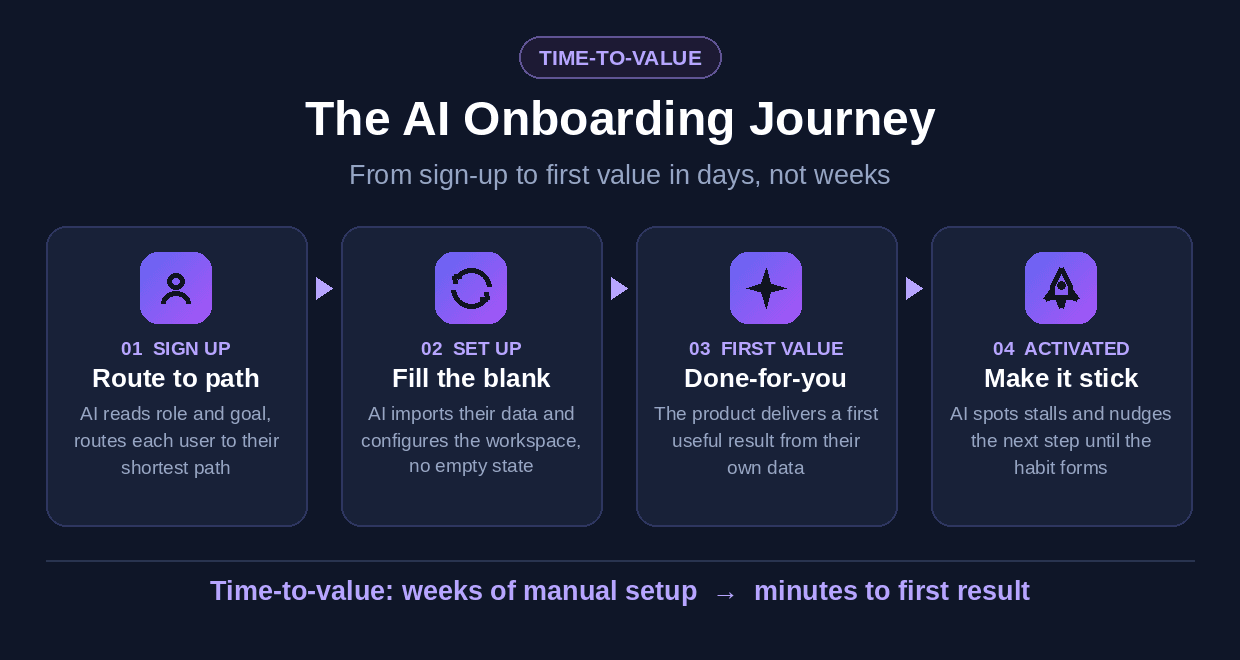
The AI onboarding journey: four stages where AI compresses time-to-value.
What time-to-value really is (and why it governs churn)
Time-to-value is the time from sign-up to the moment a user gets the outcome they came for, often called the aha moment. It matters because it sits upstream of everything else. A short time-to-value lifts activation, and activated users are the ones who convert from trial, expand, and renew. A long one does the opposite: users who never reach value churn early and silently, so the product leaks growth from a hole most dashboards do not show. Cut the time-to-value and you move activation, trial conversion and early retention at the same time.
The 7 AI onboarding workflows
1. Route each user to their shortest path. The stall: a single generic tour treats a solo marketer and an enterprise admin the same, so most users wade through steps that are not theirs. The workflow: on sign-up, AI reads role, company and the goal the user states, then routes them down the shortest path to the value they came for. The payoff: fewer steps stand between sign-up and the first useful action.
2. Kill the empty state with auto-import and setup. The stall: a blank workspace asks the user to do the configuration before the product does anything, and the blank screen is where many quit. The workflow: AI ingests the user's existing data, files or connected tools and configures the workspace for them. The payoff: day one looks like a product already in use, not a setup task.
3. Deliver a first result before they build anything. The stall: value is gated behind manual setup the user has not done yet, so the aha moment is always one more step away. The workflow: the product uses the user's own imported data to generate a first real output automatically, the first report, dashboard, draft or insight. The payoff: the aha moment lands in minutes, not after a weekend of configuration.
4. Put an AI copilot inside the product. The stall: users hit a how-do-I wall, leave to search the docs, and many never come back. The workflow: an in-app AI assistant answers in context and, where it can, performs the step for the user. The payoff: questions get resolved without leaving the product or filing a ticket.
5. Nudge on behaviour, not on a timer. The stall: a fixed email drip fires the same messages whether or not the user has actually progressed. The workflow: AI watches where each user stalls and sends the right nudge, in-app or by email, at the moment it will help. The payoff: activation prompts arrive when they are relevant, not as noise the user tunes out.
6. Catch stalls before they become silent churn. The stall: accounts that freeze short of first value disappear quietly, and no one notices until renewal. The workflow: AI flags users stuck before activation and triggers a recovery, a targeted prompt or resource, or an alert to a human for high-value accounts. The payoff: fewer accounts die unseen in the gap between sign-up and value.
7. Onboard the whole team, by role. The stall: the first user activates, but invited teammates land in the same generic flow and never get going, so the account stays single-player. The workflow: when teammates are invited, AI onboards each one by their role and gives each a path to their own first value. The payoff: the account reaches team-wide value, which is where retention actually lives.
Sequence them, do not build all seven at once
These compound, but you do not deploy them together. Find your biggest onboarding drop-off first, the single stage where most users stall, which for many products is the empty state or the step just before first value. Apply the one workflow that fixes that stage, confirm it moves the number, then add the next. A reliable order for most SaaS is: deliver a first result automatically, kill the empty state, then route users to personalized paths, and layer nudges and stall-recovery on top once the core path is fast.
Workflow | Onboarding stage | Metric it moves |
|---|---|---|
Personalized path | Sign-up | Steps to first action |
Auto-import / setup | Set-up | Empty-state drop-off |
Done-for-you first result | First value | Time-to-first-value |
In-app AI copilot | Set-up to value | Support tickets, self-serve rate |
Behaviour-based nudges | Activation | Activation rate |
Stall detection | Activation | Early churn |
Team-wide onboarding | Expansion | Seats activated per account |
Measure the clock, not the clicks
Judge these workflows on a short list of numbers, not on how slick the flow looks. Track time-to-first-value and overall time-to-value, activation rate, onboarding completion, and first-30-day retention. If time-to-value falls while activation and early retention rise, the workflows are working. If completion goes up but retention does not, users are finishing a flow without reaching real value, and the aha moment, not the checklist, is what needs fixing.
What stays human
AI removes the repetitive friction in onboarding. It does not remove the people. For complex or enterprise onboarding, a human still runs the high-stakes, high-touch moments, the kickoff, the tailored solution design, the relationship. What changes is where that human spends their time: on the few accounts and moments that genuinely need judgment, instead of chasing every new user through setup. The workflows handle the many so the team can handle the few.
From workflows to one intelligent onboarding system
Any one of these workflows is easy to describe and hard to run well, because each depends on AI reaching into your real product, your data and your tools, and behaving reliably for every new user. Wiring them together into an onboarding that actually moves time-to-value is the work most teams stall on. That is where Wedigtech comes in: not another onboarding tool, but the partner that designs, builds and runs the AI-led systems that get your users to value faster, inside the product you already have.
If you want to find where your onboarding loses users today, and which of these workflows would cut your time-to-value first, that is a short conversation worth having.
Was this helpful?
Ready to architect your next stage of growth?
Partner with wedigtech and turn ambition into compounding, measurable outcomes.
More from Insights
View All

How to Automate a Services Business With AI in 2026
How to automate a services business with AI in 2026: the six places to automate across the client lifecycle, the sequence to do it in, and what to keep human.
Read More
20 AI Agents for a Founder's Daily Department Reporting
20 AI agents that report a founder's daily numbers from every department: sales, marketing, finance, product, support, operations and people, rolled into one morning brief.
Read More
Your Second COO Is AI: How D2C Brands Run Operations on Autopilot
Every D2C founder is secretly the COO — running inventory, support, fulfilment and reporting in the gaps. Here's how AI becomes your second COO: watching the business 24/7, flagging problems early, and running the operational busywork.
Read More