Aug 25, 2026

Reclaim 20+ Hours a Week: The D2C AI Operations Playbook
The Founder Who Was Too Busy to Grow the Business
A D2C founder described her Tuesday: two hours answering overnight customer queries, ninety minutes assembling the weekly performance report from three platforms, forty-five minutes chasing a supplier on a delayed shipment, an hour writing product descriptions for a new launch. By mid-afternoon she had done nothing that actually moved the business forward. She had run the business, but she had not grown it.
She is not an outlier. She is the median D2C founder at the Rs 2 crore to Rs 20 crore revenue stage — the point where the business is real, the volume is heavy, and the founder is still personally holding the operations together.
The direct answer to where the time goes: it is scattered across five operational areas, none of which requires the founder's judgment, all of which quietly consume the week. AI-led operations give those hours back — not by replacing the team, but by moving execution off the founder's plate. Here is exactly where the 20+ hours come from, and how to reclaim each block.
What Manual Operations Actually Cost
The scale of the loss is well documented. Businesses that systematically move manual operations to automation reclaim 15 to 30 hours per week within the first quarter, and Indian D2C teams specifically report getting 48 to 57 hours back weekly across support, logistics, payments, and analytics, according to BePragma's Indian D2C automation playbook (2026). Even the conservative baselines land high: founders save 8 to 12 hours a week on content and scheduling alone (Monolit 2026), and marketers save an average of 6.1 hours weekly from AI agents, with senior operators saving 8 to 10 (HubSpot AI Trends 2026).
For a D2C founder wearing five hats, those numbers stack. The founder is the support lead, the analyst, the marketer, the ops manager, and the content team at once — so every hour AI removes from any of those functions is an hour removed from the founder's own week. That is why the recovery for a founder is consistently higher than the per-function averages suggest.
The cost of not doing it is not just time. Every hour spent assembling a report or chasing a shipment is an hour not spent on product, buyer relationships, or the next channel. Manual operations do not just cost hours — they cost the growth those hours would have produced.
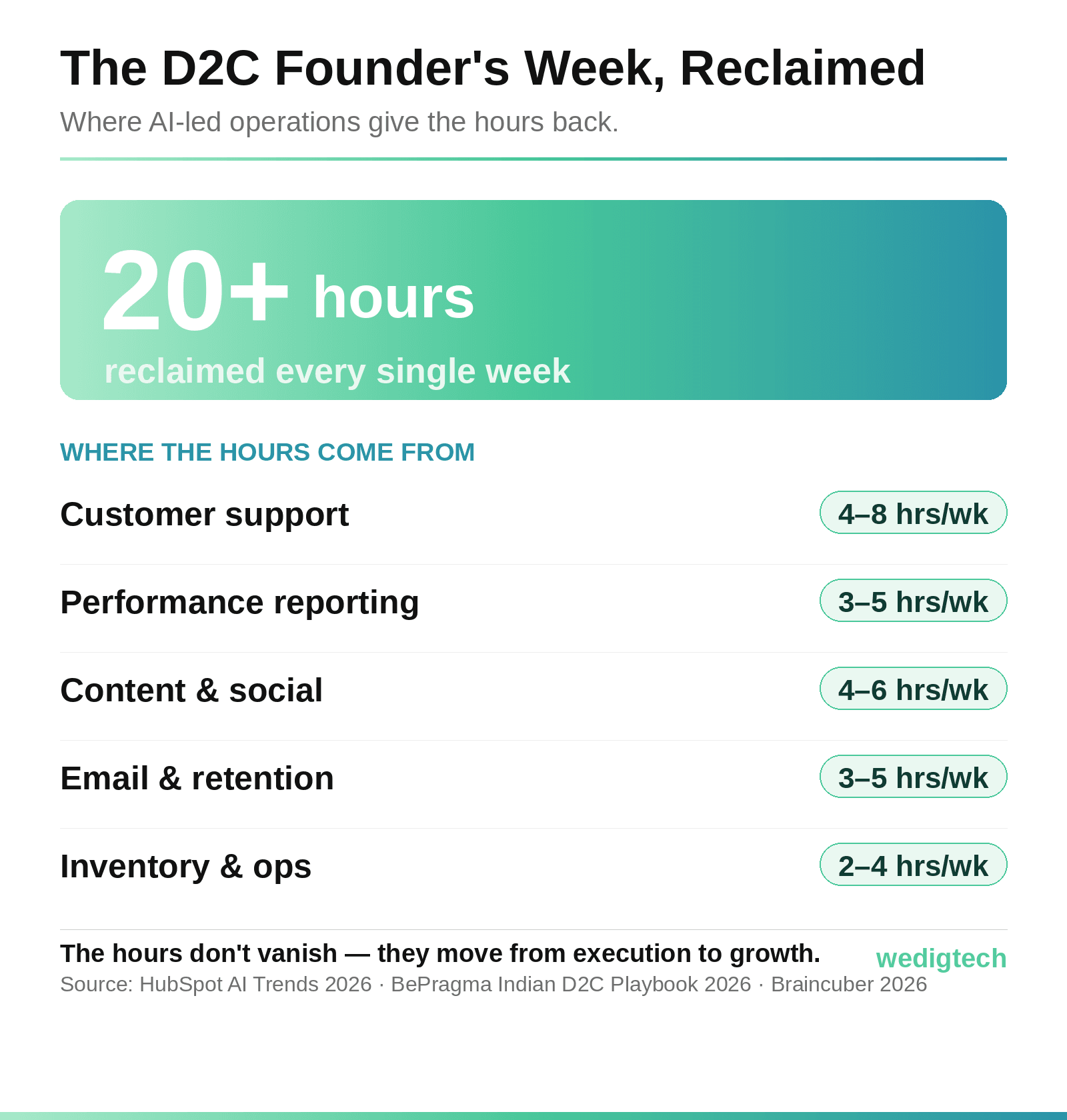
Where a D2C founder's 20+ reclaimed hours come from each week.
The D2C Operations Time Audit
Run this against your own last week. For each task, write down the hours you or a team member spent, then read across to what AI-led operations recover and what the founder does with the time instead. Add up the middle column — most founders land between 18 and 28 hours.
Task | Hours lost / week | What AI-led operations recover | What the founder does instead |
Customer support | 4–8 hrs | AI agent resolves 70–80% of tickets; support cost down 40–60% | Review escalations only — 30 min a day |
Performance reporting | 3–5 hrs | Unified dashboard auto-generates a daily digest | Read the digest, not build it |
Content & social | 4–6 hrs | AI drafts descriptions, captions, ad copy in brand voice | Edit and approve, not originate |
Email & retention | 3–5 hrs | Behavioural sequences run without manual sends | Review performance weekly |
Inventory & ops | 2–4 hrs | Real-time sync flags stockouts and reorder points | Approve decisions, not discover problems |
The recovery is real because these tasks share one trait: they are execution, not judgment. A properly deployed AI operations layer cuts support costs 40 to 60% and delivers its first visible wins within 30 days, based on 23 US Shopify D2C implementations, according to Braincuber (2026). The founder does not leave the decisions — they leave the doing.
Where the Hours Actually Go After You Reclaim Them
The reclaimed hours are worth far more than the time itself, because of where they move. A founder who gains back 20+ hours a week does not get 20 hours of rest. They get 20 hours redirected to the work that only a founder can do: product direction, buyer and partner relationships, new channel exploration, and the strategic calls that decide whether the business plateaus or compounds.
This is the real mechanism behind AI-led operations. It is not a cost-cutting story about doing the same work with fewer people. It is a leverage story about moving the founder from the centre of execution to the centre of strategy — and letting the systems hold the operations that used to hold the founder hostage.
What This Looks Like in Practice
Indian D2C brands give concrete examples of the mechanism working. One brand automated real-time inventory sync across Shopify, Nykaa, and Amazon — cutting refund-related cancellations from 3% to 0.8% and saving roughly six hours a week on manual stock checks alone, according to BePragma (2026). The same playbook shows reporting — the Monday-morning ritual of downloading CSVs and cleaning spreadsheets — consuming around four hours a week before it was automated away.
None of these brands cut their team to achieve this. They moved the mechanical work to systems and kept their people on the work that required a human. The founder's week got 20+ hours lighter, and every one of those hours had somewhere more valuable to go.
From Founder-Led Operations to a System That Runs Itself
Reclaiming 20+ hours is the visible result. The deeper shift is structural — moving from a business that stops when the founder stops to one that runs, improves, and compounds without the founder holding it together. That is not a matter of buying five tools. It is a matter of designing the operations layer that connects them and defines who owns what.
Wedigtech's Operating System and Technology System are built to design exactly that transition for growth-stage D2C brands — mapping every manual block the founder currently owns, identifying the AI system that recovers each one, and installing the oversight model that keeps quality high without the founder's daily presence. Because Wedigtech takes equity in the outcome, the system is built to keep compounding after Month 6 — an operating layer that gets sharper as it runs, not one that needs rebuilding every quarter.
Was this helpful?
Ready to architect your next stage of growth?
Partner with wedigtech and turn ambition into compounding, measurable outcomes.
More from Insights
View All
20 AI Agents for a Founder's Daily Department Reporting
20 AI agents that report a founder's daily numbers from every department: sales, marketing, finance, product, support, operations and people, rolled into one morning brief.
Read More
Your Second COO Is AI: How D2C Brands Run Operations on Autopilot
Every D2C founder is secretly the COO — running inventory, support, fulfilment and reporting in the gaps. Here's how AI becomes your second COO: watching the business 24/7, flagging problems early, and running the operational busywork.
Read More
100+ AI Tools for Services Businesses (Organized by Use)
A categorised directory of 100+ AI tools for services businesses — for proposals, CRM, scheduling, delivery, support, finance, marketing and more — with what each one is best for.
Read More