Sep 30, 2026
How Smart Brands Use AI for Marketing in 2026 (Case Study + Playbook)
AI Didn't Just Speed Up Marketing — It Changed What's Possible
A few years ago, 'using AI in marketing' meant a smarter email send-time or a chatbot on the website. Today, the brands people talk about are using AI to do things that were simply impossible before: give every single customer a different experience, generate thousands of creative variations, and turn their own customer data into marketing that spreads on its own. The gap between brands that treat AI as a gimmick and brands that build it into how they market is now the gap between staying visible and disappearing.
This piece breaks down the six ways new-age brands actually use AI for marketing, then goes deep on one brand that does it better than almost anyone — Spotify — and pulls out exactly what any brand, at any size, can learn from it.
The six ways new-age brands put AI to work across marketing.
The Six Ways New-Age Brands Use AI in Marketing
1. Hyper-personalization — The biggest one. Instead of one message for everyone, AI tailors content, product recommendations, and offers to each individual based on their behaviour. Done well, every customer feels like the brand is speaking directly to them — and personalization consistently lifts engagement, conversion, and retention.
2. AI content generation — Brands use AI to produce copy, creative, images, and even video at a volume and speed a human team can't match — social posts, ad variations, product descriptions, email copy — freeing people to focus on strategy and brand voice.
3. Generative campaigns and experiences — Beyond static content, AI now generates whole interactive experiences — personalized microsites, AI-made ad creative tested and served automatically, and campaigns that adapt to each viewer.
4. Conversational AI — AI assistants that guide shoppers from a vague idea to the right product, answer questions, and handle support — turning the brand's presence into something interactive rather than static.
5. Predictive targeting — AI decides who to target, when to reach them, and what to say — spotting the customers most likely to buy or churn, and acting before a human would even notice the signal.
6. AI-search optimization (AEO) — As buyers increasingly research through ChatGPT and AI Overviews, brands are optimizing to be cited inside AI answers — the new front door to discovery.
Deep Case Study: How Spotify Turned AI Into Its Marketing Engine
No brand illustrates the full power of AI in marketing better than Spotify. What makes it worth studying isn't a single clever campaign — it's that Spotify built AI into the core of both its product and its marketing, and created a loop where each one feeds the other. Here's how it works.
It started with personalization as the product. Spotify uses machine learning to study every user's listening behaviour and build experiences around it — Discover Weekly, Daylist, and the voice-driven AI DJ that acts like a personal radio host, choosing music for the moment and talking you through it. This isn't AI for its own sake; it's AI that makes the experience feel personal and effortless. And it works: AI-driven features like Discover Weekly and AI DJ keep 72% of users coming back weekly, AI users spend 140 minutes a day versus 99 for non-AI users, and AI-recommended users show 40% higher retention.
Then it turned that personalization into marketing. This is the genius move. Spotify Wrapped — the yearly, AI-generated summary of each user's listening — takes the brand's personalization and turns it into a cultural event people voluntarily share. Users become the marketers. Wrapped and similar features generated an estimated 2.5 billion impressions across TikTok and X and roughly $250M in earned media value. Spotify didn't buy that reach; its AI-personalized data created content so personal that people wanted to post it.
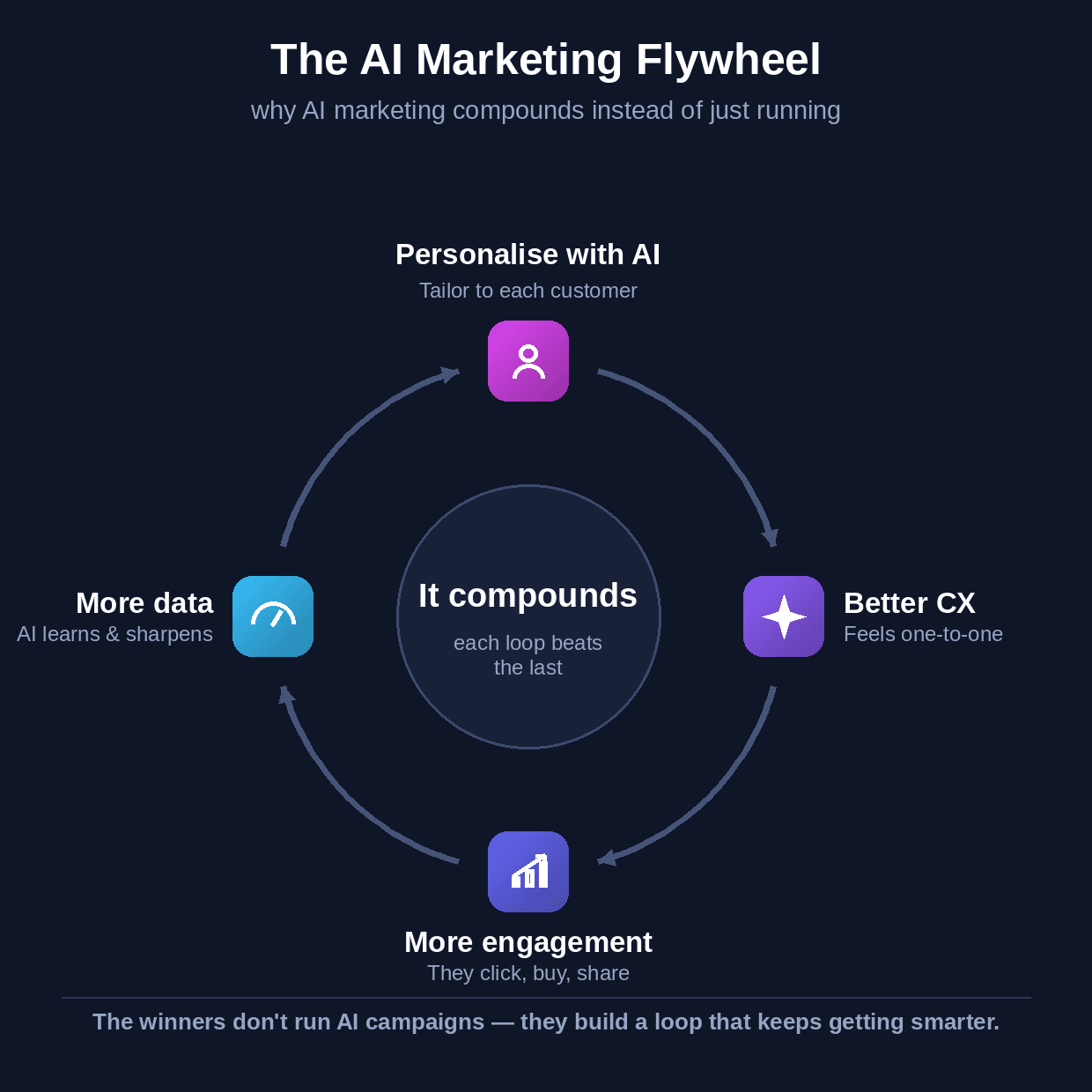
And it all compounds. The more Spotify personalizes, the more people engage; the more they engage, the more data Spotify has to personalize further — a self-reinforcing flywheel. That loop shows up directly in the business: personalized playlists contribute to 46% of premium conversions, AI-targeted advertising grew 17% year over year, and AI is cited as a core driver of Premium's growth to 252M subscribers.
40% higher retention for AI-recommended users | 46% of Premium conversions from personalized playlists | $250M earned media from Wrapped (est.) |
Spotify's AI marketing, by the numbers (Statista 2026, Kantar Media 2026, industry analyses).
The Real Learning for Everyone Else
It's easy to look at Spotify and think 'that's a tech giant with resources I don't have.' But the lessons underneath are not about scale — they're about approach, and they transfer to any brand.
1. Personalization is the highest-leverage use of AI — Spotify's entire advantage is making each person feel understood. You don't need Spotify's data science to start — you need to use the customer data you already have to make your marketing feel one-to-one instead of one-to-all. That's where AI pays back first.
2. Turn your data into marketing people share — Wrapped works because it gives each user something personal enough to post. Any brand can apply this: use AI to give customers a personalized result, insight, or summary they'll want to share. Your customers can become your best distribution channel.
3. Build the flywheel, not the one-off — Spotify's edge isn't one campaign; it's the loop where personalization drives engagement, engagement creates data, and data improves personalization. Design your AI marketing so each cycle makes the next one better.
4. AI serves the experience, not the other way around — Every Spotify feature makes the experience more personal and effortless — the AI is invisible. The lesson: don't add AI to look modern; add it where it genuinely makes the customer's experience better.
And the most important learning of all, confirmed across the brands winning with AI marketing in 2026: the winners aren't the ones using the newest AI models — they're the ones who built the right system around them. Connected data, a clear brand voice the AI works within, and human ownership of what ships. AI produces the volume; the system is what makes it work. A brand with a mediocre model and a great system beats a brand with the best model and no system, every time.
From AI Marketing Ideas to an AI Marketing System
This is exactly where most brands get stuck. The ideas are clear — personalize, generate, build a flywheel. The hard part is building the system underneath: connecting your customer data so the AI has something to act on, wiring the tools together, setting the brand standards and human review gates, and getting it all running as one engine rather than a pile of disconnected apps. That gap between 'we should use AI in marketing' and a working AI marketing system is where the value is won or lost.
That's the work Wedigtech does with growth-stage brands — designing and building the intelligent marketing systems that make AI actually deliver: the data foundation, the automation, and the AI layer on top, built and run as one system. Not another tool to manage, but a marketing engine that compounds like the ones the best brands have.
If you'd like to look at how AI could be built into your own marketing — where personalization would pay back first, and what the system behind it should look like — that's a short conversation worth having. Book a call and we'll map it to your brand.
Was this helpful?
Ready to architect your next stage of growth?
Partner with wedigtech and turn ambition into compounding, measurable outcomes.
More from Insights
View All

Build AI Products and Operations Without Fronting the Cost: The Wedigtech Model
Most businesses fund 100% of their technology upfront and carry all the risk. Wedigtech's co-investment model is different: you invest ~30%, Wedigtech invests ~70%, and economics align to the value created.
Read More
The Best AI Tools to Automate B2B SaaS RevOps in 2026
The best AI tools to automate B2B SaaS RevOps in 2026 — the full stack by layer, from CRM and enrichment to forecasting and automation, with what AI does in each and where to start.
Read More
How to Find a Technology Partner for Your Mobile App Development in 2026
How to find a technology partner for mobile app development in 2026: the green flags to look for, the red flags to avoid, the exact process to shortlist and vet one, and the questions to ask.
Read More