Aug 25, 2026

6 AI Marketing Agents Every B2B SaaS Needs — And What Each Replaces
The Marketing Team Is Becoming a Stack
For most of the last decade, a B2B SaaS marketing team was a set of people: a content writer, an SEO specialist, a paid media manager, a marketing ops person, a data analyst, and someone doing demand gen. In 2026, that same team is increasingly a stack — a set of AI agents, each owning one of those functions, directed by a single marketer.
This is not a prediction. It is already the operating model of the highest-performing teams, and it is worth understanding as a stack rather than a pile of tools — because the agents map cleanly onto the roles they replace, and knowing which agent does what tells you exactly where your own leverage is.
The adoption is already near-universal. Scott Brinker's Martech for 2026 research found that 90.3% of marketing organisations now use AI agents somewhere in their stack, with content production agents and audience discovery agents leading at 68.9% and 40.8% adoption, according to Coseom's 2026 analysis. Here is the full stack, layer by layer — what each agent does, and the role it replaces.
What 'Agent' Actually Means Here
Before the stack, one distinction matters. An AI marketing agent is not a smarter autocomplete. It is agentic — it takes a goal like 'generate 15 qualified demos from mid-market SaaS accounts this quarter' and then decides which channels to use, what content to produce, who to target, and when to pivot, operating more like a junior team member with marching orders than software waiting for instructions, as Coseom (2026) describes it. That is why it maps to a role, not a feature — each agent owns an outcome the way a person used to.
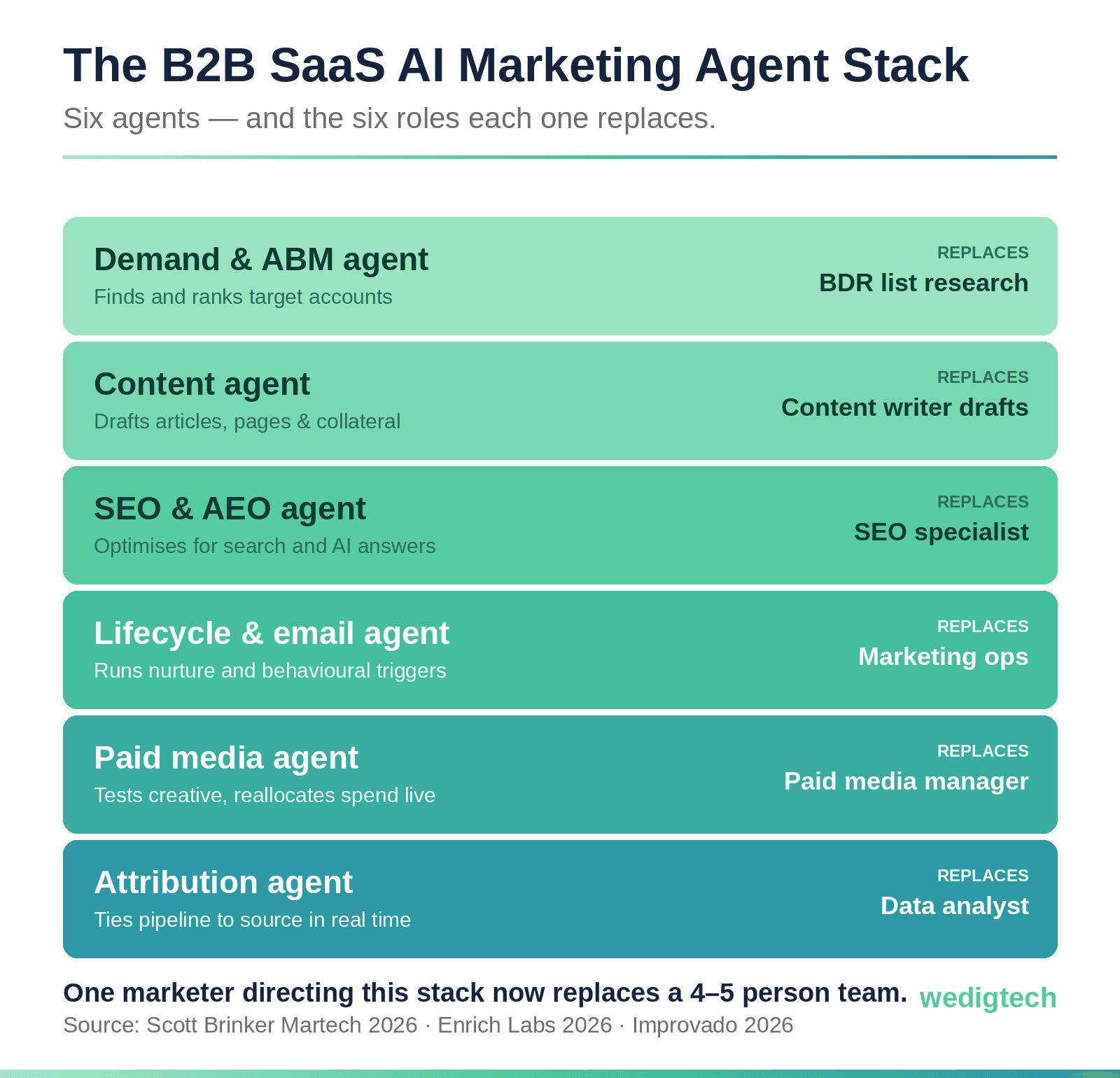
The six-layer B2B SaaS AI marketing agent stack — each agent, and the role it replaces.
The Stack, Layer by Layer
Here is the full reference. Each agent, what it actually does in production, the role it replaces, example tools, and the order most teams should deploy them in.
Agent | What it does | Replaces | Deploy order |
Content agent | Topic ideation from search demand, first drafts, on-page SEO, internal linking, post-publish monitoring | Content writer first drafts | 1st — fastest ROI, highest adoption |
SEO & AEO agent | Optimises for both search and AI answer engines; continuous detection and monitoring | SEO specialist execution | 2nd — 79% of buyers now use AI search |
Demand & ABM agent | Finds and ranks target accounts, maps buying committees, researches priorities | BDR / SDR list research | 3rd — feeds the rest of the funnel |
Lifecycle & email agent | Runs nurture and behavioural-trigger sequences, segments by ICP | Email / marketing ops | 4th — runs on first-party data |
Paid media agent | Tests hundreds of creative variations, reallocates spend in real time | Paid media manager execution | 5th — needs performance baseline |
Attribution agent | Ties pipeline to source across dark channels, reports continuously | Data analyst reporting | 6th — measures the whole stack |
The order matters because the agents are not equally easy to deploy. Content and SEO run on public signal and your own site, so they pay back fastest — one team took published SEO articles from 0 to 18 in 90 days and reversed their time split from 80% execution / 20% strategy to the opposite, according to Enrich Labs (2026). Attribution comes last because it measures everything above it.
Why It's a Stack, Not Six Point Tools
The single most important thing to understand about this stack is that its value comes from the layers working together, not from any one agent in isolation. Six disconnected AI subscriptions is not a stack — it is six more logins, each blind to the others.
The connection is where the leverage lives. When the attribution agent tells the content agent which topics actually drive pipeline, when the demand agent feeds the paid agent its target accounts, when the lifecycle agent triggers off real buying signals — the stack compounds. This is exactly why the market is converging on the pattern of 'AI platforms inside each channel, plus a layer stitching attribution across them,' as GrowthSpree (2026) puts it. The stitching is the strategy.
There is a second caveat every successful team observes: the agent output is a starting point, not finished work. The teams that win treat the content draft, the campaign, the target list as a fast first pass that a human sharpens — which is exactly what frees the human for the strategy the agents cannot do.
What the Stack Does to the Team
The org-chart implication is the headline. B2B SaaS companies with a GTM engineer — a marketer who combines AI tools with technical execution — are systematically replacing four to five equivalent headcount, according to Enrich Labs (2026), which quotes a Series B CMO directly: one person with AI tools now replaces what used to be a five-person team across sales ops, marketing ops, and demand gen. The output that required five people now requires one person directing the stack.
That is not a story about eliminating marketers. It is a story about what a marketer becomes: less an executor of tasks, more a director of agents and an owner of the strategy, positioning, and judgment that no agent can hold. The stack does the work. The human decides what work is worth doing.
From a Pile of Agents to a Growth System
Assembling the six agents is the easy part — the tools exist and are improving monthly. Making them a stack rather than a pile is the hard part, and it is the part that determines whether the leverage is real: connecting the agents through a shared data layer, defining who owns what, and building the human oversight model that keeps quality high as the agents run.
Wedigtech's Growth System is built to design and install exactly that — selecting the right agents for a specific B2B SaaS motion, connecting them into one system where the layers feed each other, and installing the oversight model that keeps the output sharp. Because Wedigtech takes equity in the outcome, the incentive is a growth stack that compounds after Month 6 — one that gets sharper as it runs, not a set of subscriptions that quietly drift out of sync.
Was this helpful?
Ready to architect your next stage of growth?
Partner with wedigtech and turn ambition into compounding, measurable outcomes.
More from Insights
View All

How to Find a Technology Partner for Your Mobile App Development in 2026
How to find a technology partner for mobile app development in 2026: the green flags to look for, the red flags to avoid, the exact process to shortlist and vet one, and the questions to ask.
Read More
Build, Buy, or Partner: How Should You Ship Your First AI Feature?
Build, buy, or partner for your first AI feature? A simple framework for B2B SaaS teams: when each path fits, the questions that decide it, and the mistakes to avoid.
Read More
How to Build an AI Business in 2026: The Founder's Blueprint
A founder's guide to building an AI business in 2026: the six-step blueprint, what AI-native really means, the traps to avoid, and how to start — from finding the right problem to building a data moat.
Read More