Aug 25, 2026
How to Automate Lead Qualification and Routing With AI (Step by Step)
Your Pipeline Is Leaking Between the Form Fill and the First Reply
There is a revenue problem hiding in plain sight in most B2B SaaS pipelines, and it is not lead volume. It is the gap between when a lead arrives and when someone qualified actually responds. The median B2B company takes 42 or more hours to respond to an inbound lead, and in one study of 939 SaaS companies only 23% responded within five minutes while 42% took more than 24 hours, according to Optifai (2026). Meanwhile, responding within five minutes makes a team up to 21 times more likely to qualify a lead than waiting an hour. The pipeline is not lost in the funnel — it is lost in the handoff.
This is an implementation problem with a clear implementation answer: let AI qualify and route every inbound lead automatically, in seconds, so the right lead reaches the right rep while intent is still hot. This is the step-by-step setup — what to build, in order, and the tools for each step. It is not a lesson in why speed matters. It is the build plan.
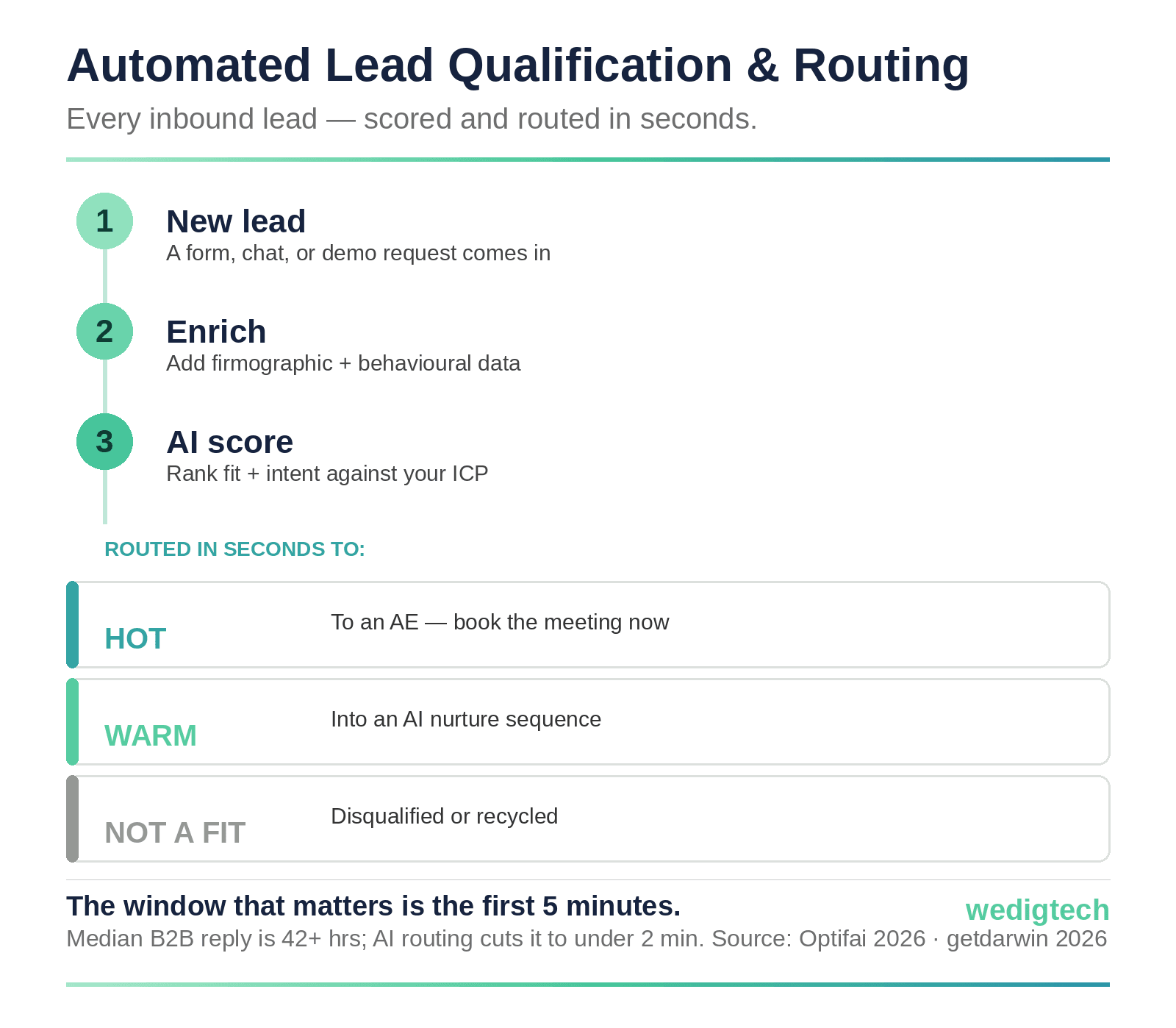
The flow: every lead enriched, scored, and routed to the right place in seconds.
The Setup, Step by Step
Step 1 — Define your ICP and scoring criteria. Before any automation, write down what a qualified lead looks like: the firmographic fit signals (company size, industry, role, region) and the intent signals (pricing-page visits, demo request, repeat sessions), and just as importantly, what makes a lead a clear no. AI scores against the criteria you define — with no definition, there is nothing to automate. This is the prerequisite step, not a formality.
Step 2 — Send every lead source into one place. Route form fills, chat conversations, demo requests, and content downloads into a single intake in your CRM. One front door is what lets one system score and route everything consistently, instead of leads scattered across tools where some never get seen — 63% of companies never respond to web-form submissions at all (RevenueHero data, 2026), usually because no one is watching that source.
Step 3 — Enrich before you route, not after. Automatically append firmographic and behavioural data to each lead the moment it lands. Order matters: sales-accepted-lead rates rise by an average of 28% when enrichment happens before routing rather than after, because the score and the assignment are made with full context, according to getdarwin (2026).
Step 4 — Score fit and intent with AI, in real time. Let an AI model rank each enriched lead against your ICP on both dimensions — fit and intent. Real-time scoring is what makes the routing that follows accurate: properly scored leads convert at around 40% versus 11% for unqualified ones (Landbase, 2026), so the score is doing real work, not decoration.
Step 5 — Route by score and rep availability, and notify fast. Assign each lead automatically based on its score plus real-time rep availability, territory, and expertise — and push the notification to Slack or SMS, not email, which is too slow for a five-minute window. Get this right and you close the gap that quietly kills deals: one in four leads is routed incorrectly today (LeanData), each misroute adding hours of delay.
Step 6 — Trigger instant follow-up to hit the window. The moment a hot lead is routed, fire the next action automatically — an instant meeting-booking link, or an AI agent that handles the first one or two touches. This is what actually captures the five-minute window at scale, and it is where SDR productivity jumps 40-70% when the agent handles the opening touches and only escalates booked, qualified conversations (getdarwin, 2026).
Step 7 — Close the loop. Feed won and lost outcomes back into the scoring model, and track three numbers: speed-to-lead, sales-accepted-lead rate, and inbound-to-meeting conversion. The system gets more accurate as it learns which scored leads actually closed — that feedback loop is what turns a one-time setup into a compounding one.
The Tools for Each Step
You do not need a custom build to run this. Here is the category of tool for each step and common options — assemble the stack that fits your CRM.
Step | What the tool does | Example tools |
|---|---|---|
Intake + CRM | The single front door and system of record | HubSpot, Salesforce |
Enrichment | Appends firmographic + behavioural data | Clay, Clearbit / HubSpot Breeze, Apollo, ZoomInfo |
AI scoring | Ranks fit + intent against your ICP | HubSpot Breeze, Salesforce Einstein, MadKudu, Clay + LLM |
Routing | Assigns by score, availability, territory | Chili Piper, RevenueHero, Default, LeanData |
Instant booking | Books the meeting in the moment | Chili Piper, RevenueHero |
Notifications | Alerts the rep fast enough to act | Slack, SMS |
A practical starting stack for most B2B SaaS teams: your existing CRM, an enrichment tool, its native AI scoring, and a routing-plus-booking tool. The point is not the specific logos — it is that each step has an owner in the stack and the leads flow between them without a human in the middle.
What to Do This Week
You can start without the full stack. Do these three things now. First, write your one-page qualification definition — the fit signals, the intent signals, and the clear disqualifiers; this is what every later step scores against. Second, measure your real speed-to-lead: submit a test lead through your own website and time how long until a qualified human responds. That number is your baseline, and for most teams it is uncomfortable. Third, turn on instant routing notifications to Slack or SMS for demo requests only — the single highest-intent source — so your fastest path to a meeting stops waiting in a queue. Those three actions cost almost nothing and move the metric that most predicts conversion.
The rest of the setup extends from there. The discipline is the same throughout: define what qualified means, enrich before you route, and close the window in minutes, not hours.
Where Wedigtech Comes In
Standing this up as a connected, reliable system — rather than a set of tools that half-work and drift out of sync — is an AI-led operations problem, and it is what Wedigtech does. Wedigtech does not run your sales team or sell you a routing tool; it builds and operates the intelligent operations layer that sits across your stack: defining the scoring, wiring enrichment before routing, connecting the tools so leads flow without a human in the middle, and instrumenting the feedback loop. The result is every lead qualified and routed in seconds, running on its own.
Was this helpful?
Ready to architect your next stage of growth?
Partner with wedigtech and turn ambition into compounding, measurable outcomes.
More from Insights
View All

20 AI Agents for a Founder's Daily Department Reporting
20 AI agents that report a founder's daily numbers from every department: sales, marketing, finance, product, support, operations and people, rolled into one morning brief.
Read More
Your Second COO Is AI: How D2C Brands Run Operations on Autopilot
Every D2C founder is secretly the COO — running inventory, support, fulfilment and reporting in the gaps. Here's how AI becomes your second COO: watching the business 24/7, flagging problems early, and running the operational busywork.
Read More
100+ AI Tools for Services Businesses (Organized by Use)
A categorised directory of 100+ AI tools for services businesses — for proposals, CRM, scheduling, delivery, support, finance, marketing and more — with what each one is best for.
Read More