Sep 4, 2026

How to Build an AI Medical Scribe App (Platform + Mobile) in 4 Weeks — 2026 Guide
Medical Documentation Is the Problem. An AI App Is the Fix — and It's Now a 4-Week Build.
Clinical documentation is the single largest source of clinician time drain and burnout. Ambient AI documentation — software that listens to a visit and generates the note automatically — has moved from experiment to proven: across five academic medical centers, ambient AI scribes cut documentation time by 16 minutes per encounter, and at Mass General Brigham clinician burnout prevalence fell from 52.6% to 30.7% within 84 days of rollout, according to JAMA (2025). Documentation time drops by around 41% — close to an hour a day per clinician (John Snow Labs, 2026).
Here is what has changed for anyone wanting to build one: the underlying tools — medical speech-to-text, clinical language models, and EHR integration standards — are now mature and available as hosted services. That means an AI medical documentation platform with a mobile app for clinicians is no longer a year-long project. Scoped correctly, it is a 4-week build. This guide is the exact plan: what to build, the stack to use, the compliance you cannot skip, and how to launch.
What You're Actually Building
Before the plan, be clear on the three pieces of the product. A mobile app that clinicians use at the point of care to capture the consented encounter and review the draft note. A web platform where notes are reviewed, edited, finalized, managed, and exported. And the AI pipeline that connects them: it takes the captured audio, transcribes it with medical speech-to-text, and uses a clinical language model to structure it into a proper note (a SOAP note or specialty format) ready for the clinician to approve.
The discipline that makes this a 4-week build rather than a year-long one is scope: one clinical workflow, one note format, hosted models rather than custom-trained ones. Everything below assumes that discipline.
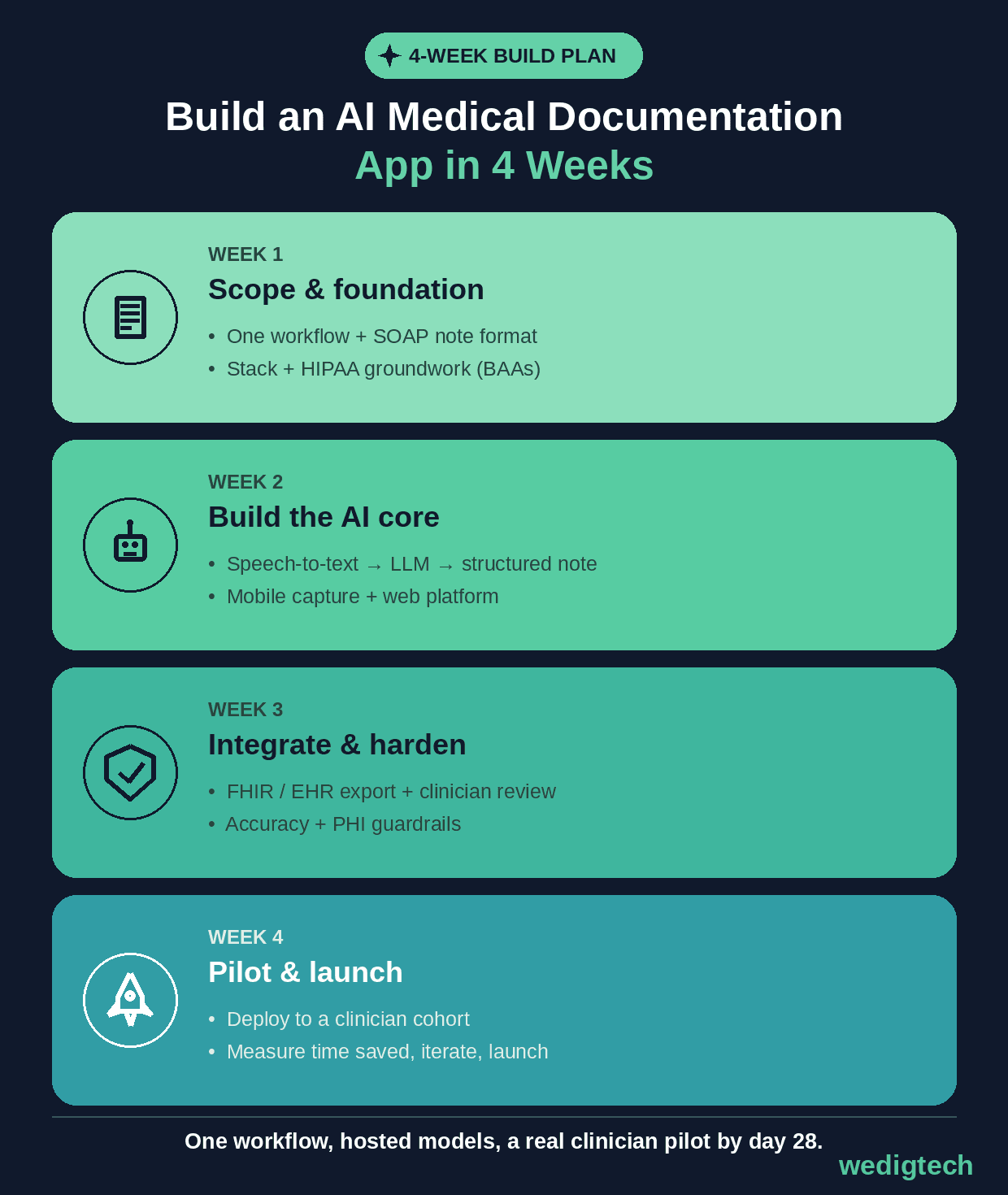
The 4-week build plan — scope and set up, build the core, integrate and harden, pilot and launch.
The 4-Week Build Plan, Week by Week
Week 1 — Scope & foundation. Pick one clinical workflow and one note format — primary-care SOAP notes are the standard starting point; do not try to cover every specialty. Stand up the stack: a medical-grade speech-to-text service, a hosted clinical language model via API, a backend and data model, and HIPAA-eligible cloud hosting. Critically, sign a Business Associate Agreement (BAA) with every vendor that will touch protected health information before any real data flows, and set up consent capture, encryption, and audit logging. This week produces no finished feature — it produces a compliant foundation the rest can be built on.
Week 2 — Build the AI core. Build the pipeline end to end: captured audio to speech-to-text transcript to a language model that structures the transcript into your note format. Then build the two surfaces around it — the mobile app capture flow (record the consented encounter, view the draft note) and the web platform (list, view, and edit notes). By the end of the week, a recorded visit produces a structured draft note. Prompt engineering on a hosted model gets you most of the way; custom model training is almost never needed and is the fastest way to blow the timeline.
Week 3 — Integrate & harden. Add EHR integration — a FHIR-based export or write-back — because EHR integration is now the buying decision: EHR-integrated deployments jumped from 28% of new enterprise contracts in 2022 to around 67% in late 2025 (HIMSS, via Sully 2026). Build the clinician review-and-approve loop so no note is finalized without a human signing off, and add guardrails against the errors, omissions, and hallucinations that AI-generated notes are known to produce. Test accuracy against your clinical bar using real, de-identified encounters.
Week 4 — Pilot & launch. Deploy to a small clinician cohort (5–10). Instrument the three numbers that prove it works: documentation time saved per encounter, note accuracy (measured by how much clinicians edit), and adoption. Fix the top friction points the pilot surfaces, then launch to a wider segment behind a feature flag. At the end of 4 weeks you have a real product in clinicians' hands, generating the evidence — time saved, notes accepted — that justifies scaling it.
The Tech Stack — What to Use for Each Layer
You do not build any of this from scratch. Here is the layer-by-layer stack and common options.
Layer | What it does | Common options |
|---|---|---|
Speech-to-text (medical ASR) | Transcribes the encounter accurately | Deepgram, AWS Transcribe Medical, Whisper, AssemblyAI |
Clinical language model | Structures the transcript into a SOAP note | Claude, GPT (hosted, via API) |
Mobile app | Point-of-care capture and review | React Native, Flutter |
Web platform | Review, edit, finalise, export notes | Standard modern web stack |
EHR integration | Export / write-back to the record | FHIR APIs; Epic, Cerner connectors |
Compliance & hosting | Protect PHI end to end | HIPAA-eligible cloud + signed BAAs, encryption, audit logs |
The Two Things You Cannot Skip: Compliance and the Human Checkpoint
Because this handles protected health information and clinical decisions, two requirements are non-negotiable and must be built in from Week 1, not bolted on later. Compliance: every vendor that touches PHI needs a signed BAA, data must be encrypted in transit and at rest, consent must be captured, and access must be audit-logged — HIPAA is a build requirement, not a launch checklist. And the human checkpoint: AI-generated notes contain errors, omissions, and occasional hallucinations, so the clinician must review and approve every note before it becomes part of the record. This is both a patient-safety requirement and a legal one — the AI drafts, the clinician signs, always.
What to Do This Week
You can start the build this week. Do these three things. First, pick the single workflow and note format — primary-care SOAP is the safe, high-volume starting point — and write down exactly what a finished note in that format should contain. Second, sign up for a medical-grade speech-to-text service and a hosted language model, and get a BAA in place with each; no PHI touches any vendor without one. Third, build the thinnest possible slice by hand: record one consented sample encounter, run it through speech-to-text and then the language model, and look at the draft note it produces. That single end-to-end pass is your proof that the core works — and it is Week 1. Everything else extends from it.
Build It in 4 Weeks — With a Partner Who's Done It
Building and shipping AI products like this — on a tight timeline, with the compliance and clinical-accuracy requirements handled — is exactly what Wedigtech does. Wedigtech co-builds and launches AI platforms and mobile apps: bringing the AI, product, design, and engineering to take a validated idea to a live, piloted product in weeks, not the year an in-house build from scratch would take. For a healthcare operator or founder with a documentation problem worth solving, that means a working, compliant AI documentation product in clinicians' hands fast — without hiring a full AI and mobile team to get there.
Book a call
If you want an AI medical documentation platform and mobile app built and launched in 4 weeks, book a 30-minute discovery call. We'll scope the workflow, the stack, and the compliance for your specific case — and map out exactly what your 4-week build would look like.
Was this helpful?
Ready to architect your next stage of growth?
Partner with wedigtech and turn ambition into compounding, measurable outcomes.
More from Insights
View All

How to Find a Technology Partner for Your Mobile App Development in 2026
How to find a technology partner for mobile app development in 2026: the green flags to look for, the red flags to avoid, the exact process to shortlist and vet one, and the questions to ask.
Read More
Build, Buy, or Partner: How Should You Ship Your First AI Feature?
Build, buy, or partner for your first AI feature? A simple framework for B2B SaaS teams: when each path fits, the questions that decide it, and the mistakes to avoid.
Read More
How to Build an AI Business in 2026: The Founder's Blueprint
A founder's guide to building an AI business in 2026: the six-step blueprint, what AI-native really means, the traps to avoid, and how to start — from finding the right problem to building a data moat.
Read More