Aug 25, 2026

The AI SOP Template That Works for Every D2C Department
Everyone Is Using AI. No Two People Use It the Same Way.
Walk through a growing D2C brand in 2026 and you will find AI everywhere — support is drafting replies with it, marketing is generating content with it, ops is asking it to summarise reports, finance is using it to categorise expenses. And you will find something else: no two people are using it the same way. One support agent's AI replies are on-brand and accurate; another's are generic and occasionally wrong. The quality depends entirely on who is at the keyboard and how good they happen to be at prompting.
That is not an AI problem. It is a missing-SOP problem. The brand has adopted AI without standardising how it is used — which means the AI is only as consistent as the least careful person using it, and all the knowledge of 'how we actually do this well' lives in a few people's heads.
The fix is an AI SOP: a standard operating procedure for how AI gets used on a task, so the output is the same quality regardless of who runs it. The good news is that you do not need a different SOP structure for every department. There is one repeatable template that works across all of them. Here it is.
Why Ad-Hoc AI Use Costs More Than It Looks
The cost of unstandardised process is well documented, and AI does not exempt a brand from it — it amplifies it. Standard operating procedures reduce errors by 60 to 80% and let a business scale without quality collapsing, according to ProcessNavigation's 2026 SOP research, while companies with documented processes cut onboarding time by up to 60% because new hires follow a guide instead of shadowing a colleague for weeks (QuickSOP 2026).
Without that documentation, a brand runs on tribal knowledge — information that lives only in people's heads and walks out the door when they leave, as QuickSOP (2026) puts it. For AI specifically, that means the one person who knows how to get good output from the tool becomes a single point of failure, and inconsistent execution shows up where it hurts most: unpredictable service alone can raise customer churn by an estimated 15% and cost supervisors an extra 10 hours a week resolving escalations, according to ProcessReel (2026). Standardising AI use is not bureaucracy. It is the difference between AI that scales quality and AI that scales inconsistency.
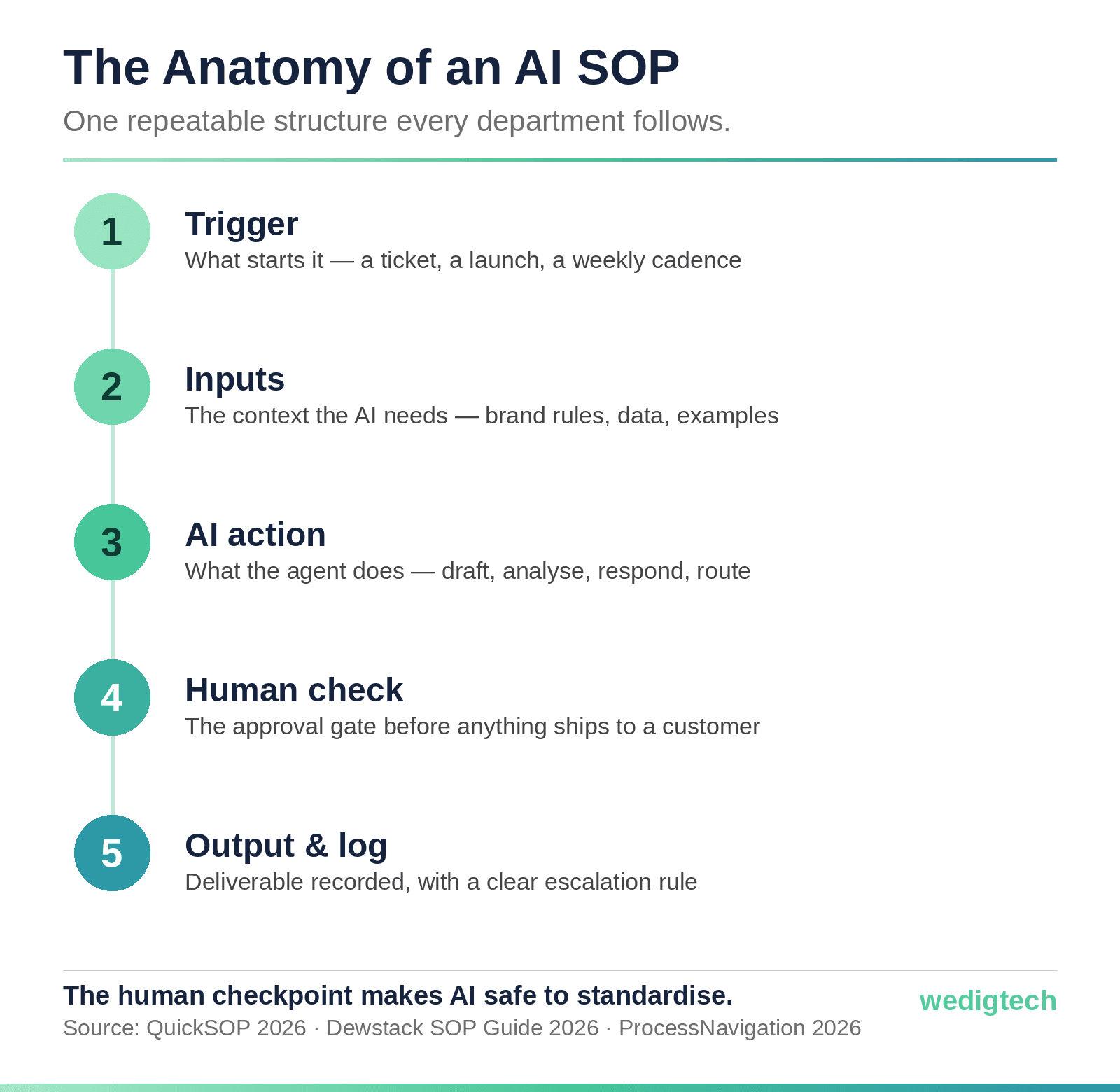
The five-part AI SOP structure — the same template every department follows.
The Five-Part AI SOP Template
Every effective AI SOP, in any department, has the same five parts. Write these five things down for any AI-assisted task and you have an SOP anyone can follow.
The trigger defines what starts the procedure — a new ticket, a product launch, a Monday reporting cadence. The inputs specify exactly what context the AI needs to do the job well: the brand voice guide, the relevant data, a few examples of good output. The AI action states what the agent actually does — draft, analyse, respond, route. The human checkpoint — the part most teams skip and the part that matters most — defines what a person reviews and approves before anything reaches a customer. And the output and log captures the deliverable, records it, and sets a clear rule for when to escalate to a human instead of letting the AI proceed.
The human checkpoint is what makes the whole thing safe to standardise. It is what lets you hand an AI SOP to a first-week employee and trust the output, because the SOP tells them exactly where their judgment is required and where the AI can run.
The Same Template, Every Department
Here is the template applied across the five departments of a typical D2C brand. Notice that the structure never changes — only the specifics do. That is what makes it followable by everyone.
Department | Trigger | AI action | Human checkpoint | Output & log |
Customer support | New ticket arrives | Drafts reply from order data + policy | Agent approves before send on refunds/complaints | Reply sent; flagged tickets escalated |
Marketing & content | Campaign or launch | Drafts copy, captions, variants in brand voice | Editor approves voice and claims | Published; performance logged |
Operations & inventory | Weekly stock review | Flags stockouts and reorder points | Ops approves purchase orders | PO raised; exceptions escalated |
Fulfilment & logistics | NDR or delay signal | Drafts customer update, suggests action | Lead approves non-standard resolutions | Update sent; pattern logged |
Finance & analytics | Month-end / daily close | Categorises transactions, drafts the report | Finance reviews anomalies | Report filed; flags escalated |
Five departments, one structure. A new hire in any of them can be handed the relevant SOP and produce consistent, on-brand, governed output on day one — because the SOP, not their individual skill with AI, is doing the work.
How to Roll These Out Without It Becoming a Binder Nobody Reads
The failure mode of SOPs is that they get written once, stored somewhere, and ignored. AI SOPs avoid this when they are treated as living documents embedded where the work happens, not as a PDF in a shared drive. Start with the two or three highest-volume tasks per department — the ones where inconsistency costs the most — and write the SOP for those first. Keep each one short: the five parts fit on a single page.
Then do the thing most brands skip: build the review cadence in. An AI SOP should be revisited as the AI improves and as the brand learns what good output looks like — the human checkpoint often loosens over time as trust is earned, and the SOP should reflect that. An SOP that is never updated becomes wrong; one that is reviewed becomes the institutional memory of how the brand uses AI well.
From Scattered AI Use to a Governed Operating System
A handful of AI SOPs is a strong start. A brand where every department runs AI through the same governed structure — consistent, documented, with the right human checkpoints and a review cadence that keeps them current — is something more: it is an operating system where AI scales quality instead of scaling chaos. That is an Operating System problem, and it is the difference between a brand that adopted AI and one that operationalised it.
Wedigtech's Operating System is built to design exactly that — mapping the tasks in each department worth standardising, writing the AI SOPs that govern them, and installing the review cadence and oversight model that keeps them living. Because Wedigtech takes equity in the outcome, the system is built to keep compounding after Month 6 — a governed AI operating layer that gets sharper as the brand learns, not a binder that goes stale the week after it's written.
Was this helpful?
Ready to architect your next stage of growth?
Partner with wedigtech and turn ambition into compounding, measurable outcomes.
More from Insights
View All

How to Find a Technology Partner for Your Mobile App Development in 2026
How to find a technology partner for mobile app development in 2026: the green flags to look for, the red flags to avoid, the exact process to shortlist and vet one, and the questions to ask.
Read More
Build, Buy, or Partner: How Should You Ship Your First AI Feature?
Build, buy, or partner for your first AI feature? A simple framework for B2B SaaS teams: when each path fits, the questions that decide it, and the mistakes to avoid.
Read More
How to Build an AI Business in 2026: The Founder's Blueprint
A founder's guide to building an AI business in 2026: the six-step blueprint, what AI-native really means, the traps to avoid, and how to start — from finding the right problem to building a data moat.
Read More