Oct 13, 2026

How to Find a Technology Partner for Your Mobile App Development in 2026
The Decision That Makes or Breaks Your App
Most apps don't fail because of a bad idea. They fail because of a bad build — scope that ballooned, a timeline that slipped for months, a product that launched buggy and then went unsupported, or a 'finished' app that no one could change afterwards. And almost always, that traces back to one decision made early: who you chose to build it with. Pick the wrong technology partner and no amount of vision survives contact with the delivery.
So the real question isn't 'who can build my app cheapest?' It's 'who will I still be glad I chose a year from now?' This guide answers that: the green flags that signal a real partner, the red flags that should make you walk away, the exact process to find and vet one, and the questions that separate the good from the plausible.
First, the Mindset Shift: Partner, Not Vendor
Here's the most important reframe, and the thing that's changed most by 2026. The old model was transactional: you wrote a spec, a vendor built exactly that, invoiced you, and left. It treated your app like a one-off project. The problem is that a great app is never 'done' at launch — it needs product judgment during the build, and it needs to evolve after it. A vendor who only executes a spec can't give you either.
A technology partner is different. They care about whether the app actually works for your business, not just whether it matches the spec. They push back when a feature is a bad idea, bring product thinking to the table, and stay engaged after launch. The entire rest of this guide is really about one thing: how to tell a partner from a vendor before you sign.
The Green Flags and the Red Flags
When you're evaluating any company, these are the signals that matter most. The green flags predict a successful build; the red flags predict the horror stories.
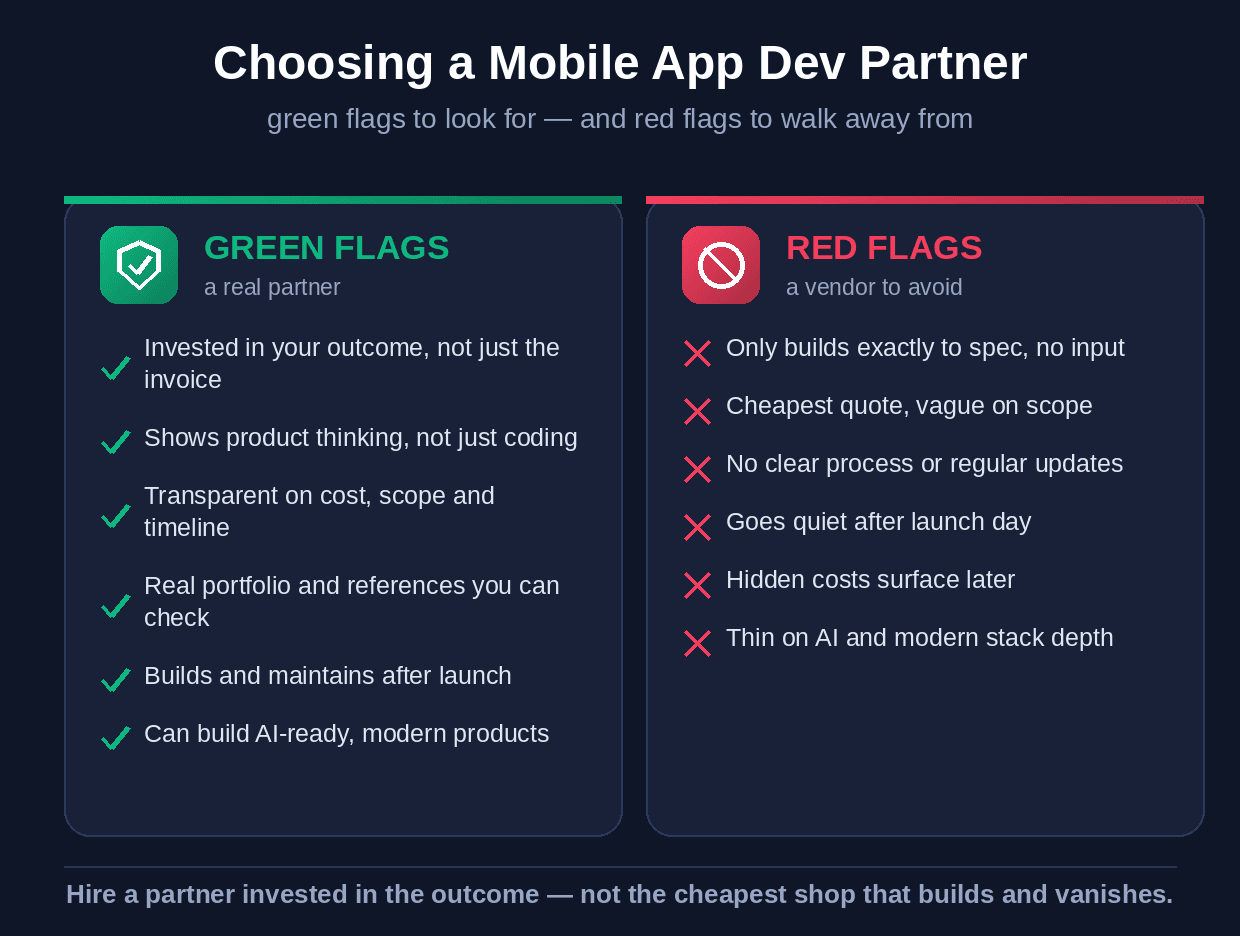
What to look for in a mobile app development partner — and what to walk away from.
The green flags are worth saying plainly. A real partner is invested in your outcome, not just the invoice. They bring product thinking — they help shape what to build, not just how to code it. They're transparent about cost, scope, and timeline from the start. They have a real portfolio and references you can actually call. They build and then maintain the app after launch. And in 2026, they can build AI-ready, modern products rather than yesterday's tech.
The red flags are just as clear, and most app disasters show at least one of them early. The cheapest quote with a vague scope almost always means change-order surprises later. No clear process or regular updates means you'll be in the dark. A company that goes quiet after launch day leaves you stranded with an app you can't evolve. Hidden costs that surface mid-build break trust and budgets. And a partner thin on AI and modern stack depth will build you something already dated. If you see these, keep looking.
The Process: How to Actually Find and Vet One
Finding the right partner is a process, not a single search. Run it in order.
1. Define before you search. Write down what the app must do, who it's for, your rough budget, and — most importantly — what success looks like in business terms (not just 'an app'). A partner can only be evaluated against a clear goal. This step also weeds out anyone who tries to quote before understanding the goal.
2. Build a shortlist. Find candidates through referrals, trusted directories, and portfolios of apps similar in complexity to yours. Aim for three to five, not twenty. Prioritise ones who've built in your space or at your scale.
3. Evaluate on the green flags. In conversations, test for the signals above. Do they ask about your business and users, or only about features? Do they push back on anything? Are they specific about process, communication cadence, and what happens after launch? Vague, agreeable, and cheap is a warning, not a win.
4. Check the proof. Review their real work and call their references — ask those references the uncomfortable questions: Did it ship on time? What happened when something went wrong? Are they still supporting it? A partner proud of their work will connect you gladly.
5. Run a small paid trial. Before committing to the whole build, do a small paid first phase — a prototype, a discovery sprint, or one module. How they handle a small engagement is exactly how they'll handle the big one. This single step prevents most expensive mistakes.
Questions That Reveal the Truth
The right questions surface what a sales deck hides. Ask: How do you decide what to build when the spec is unclear? What does your process look like week to week, and how will I see progress? What happens after launch — who maintains it, and how are changes handled? How do you handle a feature you think is a mistake? How would you add AI to this product, and should we? And plainly: what will this really cost, and what would make it cost more? The quality and honesty of the answers tell you more than any portfolio.
The 2026 Difference: AI Is Now Part of the Question
One thing has genuinely changed. In 2026, 'can they build a mobile app?' is no longer enough — the question is 'can they build a modern, AI-capable product, and build it fast?' Users increasingly expect intelligent features, and AI has compressed what used to take a year into months when the partner knows how to use it. A partner who treats AI as a real capability — not a buzzword bolted on — will build you something that's competitive the day it ships and ready to evolve. One who doesn't will quietly hand you a dated app. Make AI capability part of your evaluation, not an afterthought.
What to Do This Week
Don't start by collecting quotes. Start by writing one page: what the app must do, who it's for, your budget range, and what business outcome would make it a success. That page is what lets you tell a partner from a vendor — because a real partner will engage with the outcome, and a vendor will skip to the quote. Then find three candidates whose past work resembles what you need, and in the first call, notice who asks about your business and who only asks about features. That single afternoon of preparation will shape the single most important decision in your app's life.
What a True Partnership Looks Like
Everything above describes a partner who's invested in your outcome rather than your invoice — and that's exactly the shift Wedigtech is built around. Rather than building to a spec and leaving, Wedigtech partners with businesses to design, build, and run AI-powered products and platforms, bringing the product thinking, AI capability, and long-term commitment that a modern app actually needs — with economics aligned to the value created, not just hours billed. It's the difference between hiring someone to write code and gaining a partner who's as invested in the app's success as you are.
If you're weighing how to build your mobile app — and want a partner who'll treat it as a product to get right, not a project to close — that's a short conversation worth having. Book a call and we'll talk through what you're building and what the right partnership would look like.
Was this helpful?
Ready to architect your next stage of growth?
Partner with wedigtech and turn ambition into compounding, measurable outcomes.
More from Insights
View All

20 AI Agents for a Founder's Daily Department Reporting
20 AI agents that report a founder's daily numbers from every department: sales, marketing, finance, product, support, operations and people, rolled into one morning brief.
Read More
Your Second COO Is AI: How D2C Brands Run Operations on Autopilot
Every D2C founder is secretly the COO — running inventory, support, fulfilment and reporting in the gaps. Here's how AI becomes your second COO: watching the business 24/7, flagging problems early, and running the operational busywork.
Read More
100+ AI Tools for Services Businesses (Organized by Use)
A categorised directory of 100+ AI tools for services businesses — for proposals, CRM, scheduling, delivery, support, finance, marketing and more — with what each one is best for.
Read More