Sep 22, 2026
How to Use AI for Marketing: A 90-Day Playbook for B2B SaaS
Marketing Changed Under Your Feet — Here's How to Catch Up in 90 Days
Two things happened to B2B SaaS marketing at once. AI made it possible to produce and run marketing at a pace a small team never could — and AI changed how buyers find you in the first place. 45% of B2B buyers now use generative AI to research vendors before they ever visit a website, according to Gartner (2025), which means your content has to be citable by ChatGPT and AI Overviews, not just rankable in Google. Most teams are reacting to this piecemeal and getting little for it.
This is the plan that works instead: a 90-day playbook to put AI to work across your marketing, in the right order — with the tools to use at each stage and a clear split of what to do yourself versus hand to AI. By day 90 you have an AI-powered marketing engine, not a pile of subscriptions.
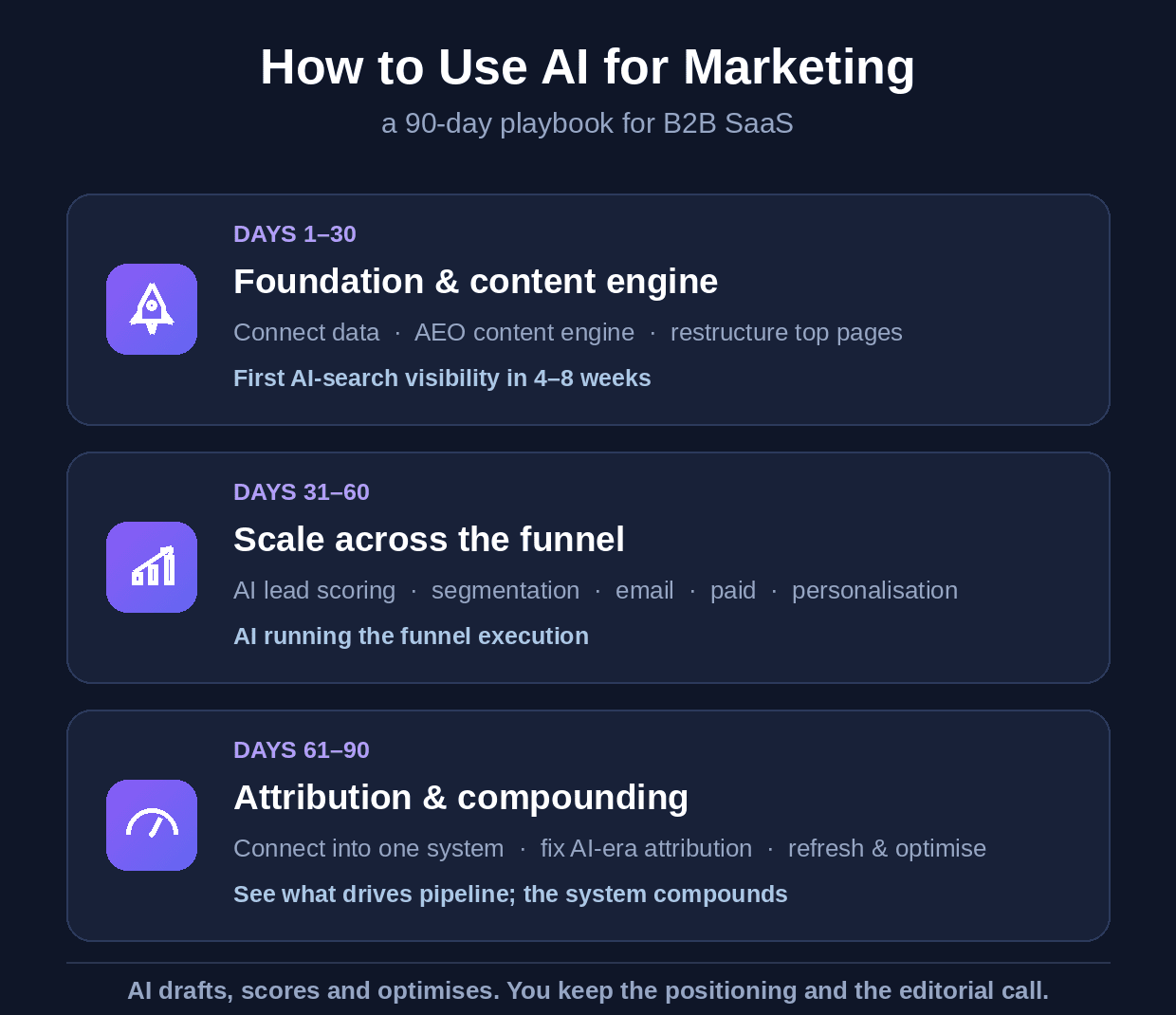
The 90-day plan — build the engine, scale the funnel, then connect and measure.
The One Rule That Keeps This From Going Wrong
Before the phases, internalise the line that separates teams who win with AI from teams who produce forgettable noise: AI drafts, scores, and optimises — humans keep the positioning, the story, and the editorial call on what actually ships. AI does not earn the right to decide what your company stands for or to publish unread. Every step below assumes a human edits and owns the output.
Days 1–30: Build the Foundation and the Content Engine
The first 30 days are about the highest-leverage play in B2B SaaS — content — and the data underneath it. Content marketing generates roughly 3x more leads than paid advertising at 62% less cost, and companies publishing 16+ pieces a month see about 3.5x more inbound traffic. AI is what lets a small team hit that volume.
1. Connect your data and find the real questions. Pull your CRM, analytics, and existing content into one place. Build your keyword list the 2026 way: combine a volume tool (Ahrefs, Semrush) with an AI prompt-mining tool, and mine your own CRM and sales calls for the exact phrasing buyers use. Prioritise by question specificity and intent, not search volume — the high-intent long-tail questions are what AI answer engines cite.
2. Stand up the AI content engine. Set up a workflow where AI produces first drafts and a human edits and owns them. Write answer-first: lead with the direct answer, then expand — that's what makes content extractable by AI assistants. Target 2-4 pieces a week.
3. Restructure your top pages for AI search (AEO). Rework your most important existing pages — homepage, pricing, comparison, key solution pages — to be answer-first, add Organization, Product, FAQ, and Article schema, and put a real 'last updated' date on them. That date alone is roughly a 15% citation lift; fresh content is about 3x more likely to be cited.
Set the expectation: most B2B SaaS brands begin seeing visibility shifts in four to eight weeks once content is restructured.
Days 31–60: Scale AI Across the Funnel
With the content engine running, month two puts AI on the rest of the funnel.
1. AI lead scoring and routing. Score every inbound lead on fit and intent automatically and route the hot ones to sales instantly — turning a pile of undifferentiated leads into a prioritised queue.
2. Dynamic segmentation and AI email. Let AI segment your audience by behaviour and fit in real time, and run behaviour-triggered nurture off it.
3. AI paid optimisation. If you run paid, put AI on autonomous campaign optimisation and creative testing — where the efficiency gains now come from.
4. Personalisation at scale. Use AI to tailor what different segments see on your site and in your content.
Days 61–90: Connect It, and Fix Attribution for the AI Era
The final phase turns tools into a system and answers the question every founder asks: what's actually working?
1. Connect the tools into one system. Wire your content engine, scoring, email, and analytics together so data flows between them — behaviour informs the score, the score informs the nurture, and everything feeds one view.
2. Fix attribution for AI search. Traditional attribution misses the new journey, because much of it now happens inside AI assistants — the 'dark funnel'. Track LLM referral sessions tagged in GA4, branded search volume (it lags citations 30-90 days), and direct-traffic anomalies on high-intent pages. Report revenue that had any AI-assistant touch, not just the final click.
3. Refresh and optimise. Institute a content refresh cadence — content over three months old drops sharply in AI citations — and feed what's converting back into the engine.
The Tool Stack, Stage by Stage
You don't need a big budget — most of this starts on free or low-cost tools. Here's a practical stack for each stage; pick one per row that fits your CRM and price point rather than buying all of them.
Stage / job | What it does | Tools to use |
|---|---|---|
Data & analytics | Your source of truth and traffic data | GA4, Google Search Console, HubSpot or Salesforce |
Keyword + prompt mining | Find the questions buyers actually ask | Ahrefs / Semrush + an AEO tool (Profound, Peec AI, Otterly) + your CRM & call notes |
AI content drafting | First drafts, at pace | Claude or ChatGPT + an SEO editor (Surfer, Clearscope, Frase) |
CMS & schema | Publish and make pages AI-readable | Webflow or WordPress + schema markup |
Lead scoring | Rank inbound by fit + intent | HubSpot AI, MadKudu |
Enrichment | Fill in firmographic + intent data | Clay, Apollo, Clearbit |
Email & segmentation | Behaviour-triggered nurture | HubSpot, Customer.io, Marketo |
Paid optimisation | Auto-optimise spend & creative | Performance Max, Meta Advantage+, Madgicx |
Personalisation | Tailor the site by segment | Mutiny, Intellimize |
Connect the stack | Make data flow between tools | Zapier or Make; a CDP (Segment) at scale |
Attribution & AI-search tracking | See what drives pipeline, incl. AI answers | Dreamdata or HubSpot attribution + GA4 (LLM regex) + Profound / Peec AI |
What to Do Yourself, and What to Delegate to AI
The fastest way to waste this plan is to let AI make the calls only a human should make — or to keep doing by hand the volume work AI now does better. Split it cleanly: delegate the heavy lifting, keep the judgment.
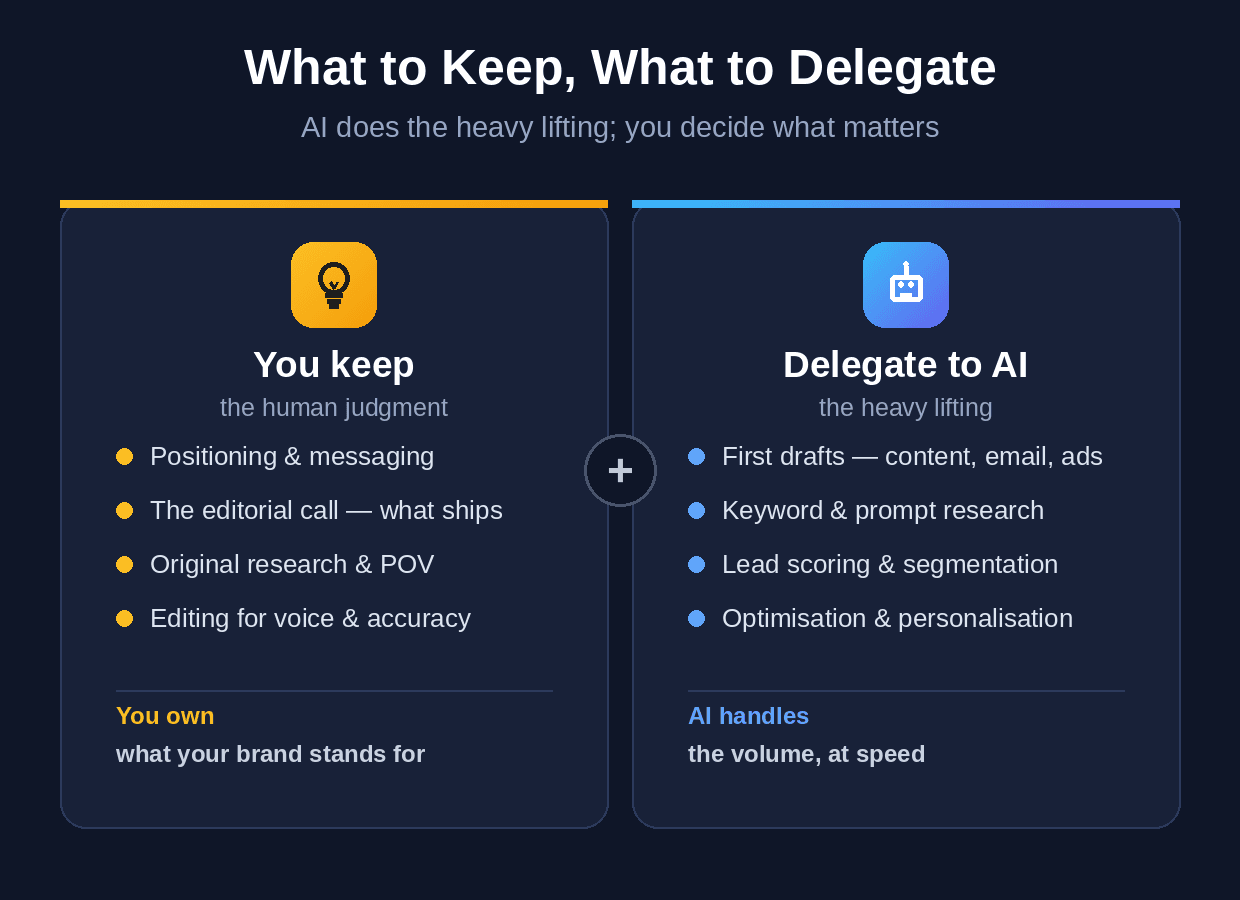
Keep the judgment; delegate the volume — that split is what makes AI marketing work.
The rule of thumb: if it defines who your company is, you do it; if it's producing or optimising volume, AI does it — and you approve it. You own the positioning, the story, the original research and point of view, and the final editorial call on everything that ships. You delegate the first drafts of blogs, emails, ads and social; the keyword and prompt research; lead scoring and segmentation; and the ongoing optimisation and personalisation. AI gets you a fast, high-volume starting point across the board — your judgment turns that volume into something that sounds like you and moves pipeline.
What to Do This Week
Don't wait for the full plan to start. Do three things now. First, open your CRM and your last ten sales calls and write down the exact questions and phrases prospects use — that list is the seed of your entire content engine, sitting in your own data. Second, take your single most important page (usually pricing or your main comparison page), rewrite the top to answer the core question directly in the first two lines, and add a real 'last updated' date. Third, set up one AI-drafted, human-edited blog post answering the highest-intent question on your list, published this week. A few hours, and the compounding engine everything else builds on is running.
Turning the Playbook Into a Working System
This plan is straightforward to read and harder to run — the difficulty is in the connecting: getting the data flowing between tools, the AI configured to your ICP and voice, the attribution actually tracking the dark funnel, and the whole thing running as one system rather than a stack of disconnected apps. That's the part most teams stall on, and it's the kind of AI-led operations work Wedigtech does with B2B SaaS teams.
If it would help to map this to your own marketing — what to build first, which tools fit your stack, and how to measure it in the AI-search era — that's a short conversation worth having, and you can book a call to walk through your 90-day plan together.
Was this helpful?
Ready to architect your next stage of growth?
Partner with wedigtech and turn ambition into compounding, measurable outcomes.
More from Insights
View All

How to Find a Technology Partner for Your Mobile App Development in 2026
How to find a technology partner for mobile app development in 2026: the green flags to look for, the red flags to avoid, the exact process to shortlist and vet one, and the questions to ask.
Read More
Build, Buy, or Partner: How Should You Ship Your First AI Feature?
Build, buy, or partner for your first AI feature? A simple framework for B2B SaaS teams: when each path fits, the questions that decide it, and the mistakes to avoid.
Read More
How to Build an AI Business in 2026: The Founder's Blueprint
A founder's guide to building an AI business in 2026: the six-step blueprint, what AI-native really means, the traps to avoid, and how to start — from finding the right problem to building a data moat.
Read More