Aug 25, 2026
The AI Repeat-Purchase System: How to Build It
The Tools Exist. The Question Is How to Implement Them.
Increasing repeat purchases is rarely a strategy problem. Most businesses already know they should win more repeat orders, and the AI tools to do it already exist. The gap is implementation: knowing exactly what to set up, in what order, and how to connect it so it runs on its own. This guide is that implementation plan — what to build, when each piece fires, and the exact actions to take.
The approach here is deliberately practical. Rather than another explanation of why retention matters, it lays out the specific AI plays that drive repeat orders and how to stand each one up as a connected system. By the end you will have a concrete build list you can start on this week.
The One Rule That Decides Whether It Works
Before the build list, one principle governs everything: these plays only work when they are implemented as a connected system, not as separate tools. Businesses that treat AI personalisation and retention automation as connected systems — where a purchase event triggers the right message at the right time, informed by everything else known about that customer — see significantly higher repeat purchasing than those running isolated point tools, according to Intempt's 2026 analysis. So the implementation goal is not 'buy five AI tools.' It is 'connect the data so each play fires automatically off the others.' That distinction is the difference between an AI-led operation and a pile of disconnected subscriptions.
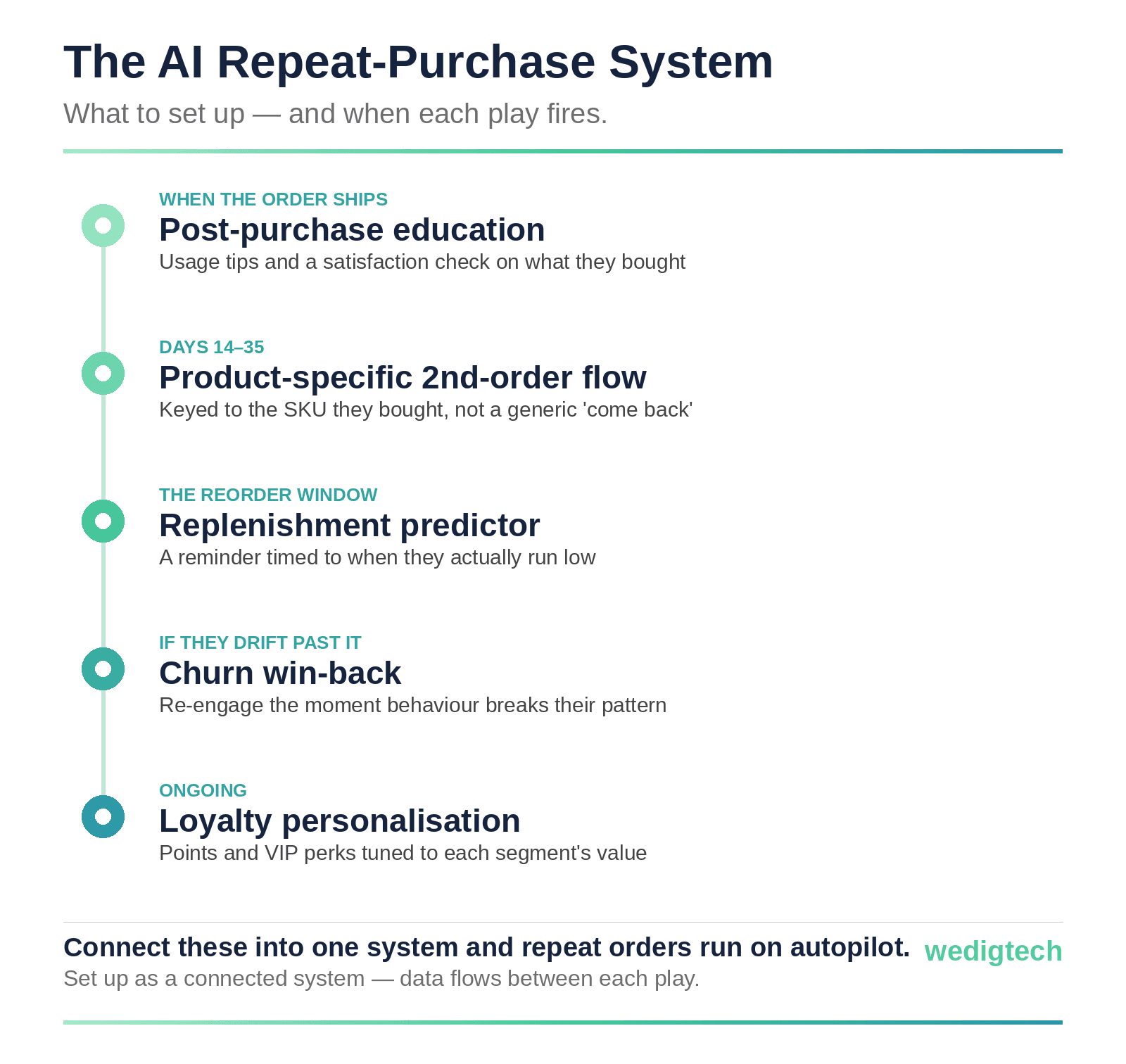
The five plays to implement — and the moment in the customer's lifecycle each one fires.
The Implementation Plan: What to Set Up, in Order
Here is the exact build order. Each step is an action you can assign and ship. They are sequenced so the fastest-return play comes first and each one builds on the data the previous steps connect.
Step | What to set up | The exact action | Why this order |
1 | Connect your data | Get orders, product usage, and email/SMS engagement flowing into one place, keyed to the customer | Everything else runs on this |
2 | Product-specific 2nd-order flow | Build a triggered sequence at days 14 / 21 / 35, keyed to the SKU bought — not a generic 'come back' | Fastest lift: +8-14 pts RPR in a quarter |
3 | Post-purchase education | Add usage tips, setup guidance, and a satisfaction check within 14 days of the first order | Lifts second-order rate 20-35% |
4 | Replenishment predictor | Calculate each product's reorder interval from purchase data; fire a reminder timed to it | Reminders convert 8-15% |
5 | Next-best-product recommender | Surface the product this customer's cohort buys next; place it in email, on-site, and retargeting | AI personalisation drives ~40% more revenue |
6 | Churn win-back | Detect when a customer drifts past their expected reorder window; auto-trigger re-engagement | Recovers repeat revenue before it's lost |
7 | Measure and iterate | Track repeat purchase rate by cohort; feed what converts back into steps 2-6 | Turns the system into a compounding loop |
Start with step 2 even before the rest is perfect. A product-specific second-order flow does not try to persuade the customer — it removes friction from a decision the satisfied ones were already inclined toward, which is why brands that implement it well lift repeat purchase rate by 8 to 14 points within a quarter, according to RetentionLab (2026). It is the single highest-return thing on this list, and most businesses have not built it.
What to Do This Week
If you do nothing else after reading this, do these three things. First, pull your order data and calculate, for your top few products, the average number of days between a customer's first and second order — that number is the trigger timing for everything else. Second, write down the exact SKU-to-SKU pattern: for your best-selling first product, what do those customers buy second? That pattern is already in your data and is the basis of your recommender. Third, stand up the day-14 second-order flow for that one product, keyed to that pattern. That single flow, live, is usually enough to move the number — and it is a concrete, finishable task, not a project.
Everything else on the list extends from those three actions. The point is to start implementing, not to wait for a perfect plan — the system gets better as it runs and as the data accumulates.
Where Wedigtech Comes In
Implementing this well is an AI-led operations problem, and it is exactly what Wedigtech does. Wedigtech does not sell retention theory — it builds and runs the intelligent systems. For repeat purchases, that means connecting your order and behavioural data into one foundation, building the AI plays above as agents that fire automatically, and operating the system so it keeps improving. The result is a repeat-order engine that runs without your team holding it together.
Because Wedigtech takes equity in the outcome, the system is built to keep compounding after Month 6 — an AI-led operation that gets sharper as it learns each customer's rhythm. If you want the system above implemented and run rather than added to your own to-do list, that is the partnership: you bring the business and the data, Wedigtech builds and operates the AI. Book a call to scope what implementing it inside your operation would look like.
Was this helpful?
Ready to architect your next stage of growth?
Partner with wedigtech and turn ambition into compounding, measurable outcomes.
More from Insights
View All

Build AI Products and Operations Without Fronting the Cost: The Wedigtech Model
Most businesses fund 100% of their technology upfront and carry all the risk. Wedigtech's co-investment model is different: you invest ~30%, Wedigtech invests ~70%, and economics align to the value created.
Read More
The Best AI Tools to Automate B2B SaaS RevOps in 2026
The best AI tools to automate B2B SaaS RevOps in 2026 — the full stack by layer, from CRM and enrichment to forecasting and automation, with what AI does in each and where to start.
Read More
How to Find a Technology Partner for Your Mobile App Development in 2026
How to find a technology partner for mobile app development in 2026: the green flags to look for, the red flags to avoid, the exact process to shortlist and vet one, and the questions to ask.
Read More