Aug 25, 2026
The Shift From Project Management Tools to Intelligent Systems
Your PM Tool Isn't the System. It's the Filing Cabinet.
Every B2B SaaS team has a project management tool. Jira, Asana, Linear, Monday — the board is full, the tickets are moving, the sprint is planned. And yet the founder or delivery lead still spends the week doing the same things: chasing status in standups, assembling the weekly report by hand, discovering a slipped deadline only after it has already slipped. The tool is busy. The work still depends on people to keep it honest.
That is the tell that you have a tool, not a system. A tool is a place where humans record what they did. An intelligent system is something that observes the work, keeps itself current, and tells you what is about to go wrong before it does. In 2026, that distinction is the whole story of where project management is going.
The direct answer to what is changing: project management is shifting from tools that track the work to systems that run it. Here is what that shift actually looks like, and how to tell where your setup stands.
Why 2026 Is the Inflection Point
The shift has a specific driver: agentic AI — systems that do not just suggest the next step but take it. As Epicflow's 2026 analysis frames it, this is the move from AI supporting work to AI agents participating in project execution — planning, monitoring progress, allocating resources, and mitigating risks autonomously. The scale of the change is being quantified. Gartner projects that up to 80% of traditional project management tasks could be handled by AI by 2030, and the market for AI in project management is forecast to reach $52.62 billion by 2030, growing at a 46% compound rate, according to Epicflow (2026).
Adoption is already moving fast. The share of enterprise applications featuring AI agents is expected to reach 40% by the end of 2026, up from less than 5% in 2025, according to Gartner data reported by Generative Inc (2026), and 66% of companies using AI agents report measurable productivity gains (Accelirate 2026). Teams deploying agentic project systems specifically report 20 to 40% reductions in coordination overhead, according to TechPlusTrends (2026) — coordination being exactly the work that consumes a delivery lead's week.
But the capability is outpacing readiness. Only 30% of project managers express confidence in their leadership's ability to implement these systems effectively, according to Hampton Global Business Review (2026). That gap between what is possible and what teams have actually adopted is the opening — the teams that close it first pull ahead on delivery speed while everyone else is still running standups.
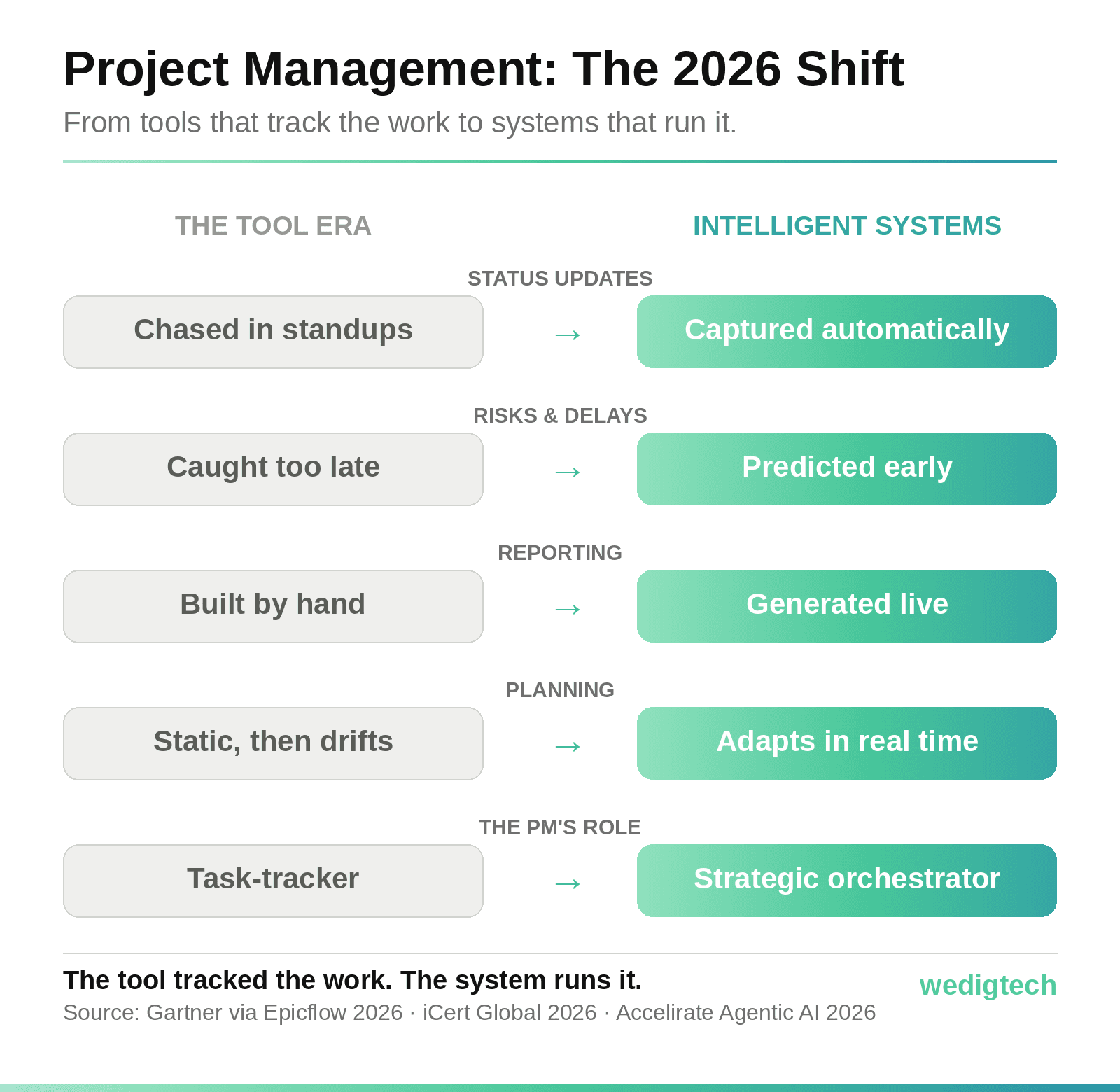
The 2026 shift — from a tool that tracks the work to a system that runs it.
The Tools-to-Systems Maturity Check
Score your own setup on each of the five dimensions below. For each one, mark whether you are still in the tool era, in transition, or running a true intelligent system. The dimensions you mark 'tool era' are where your delivery is still dependent on people holding the process together — and where the leverage is.
Dimension | Tool era | Transitional | Intelligent system |
Status updates | Chased manually in standups and DMs | Some automated reminders and integrations | Captured automatically from the work itself |
Risks & delays | Discovered after they've already happened | Flagged by manual review of the board | Predicted before they hit, with forecast dates |
Reporting | Built by hand each week from multiple tools | Semi-automated dashboards, still assembled | Generated continuously, no human assembly |
Planning | Static plan that drifts from reality | Re-planned periodically in review meetings | Adapts in real time as conditions change |
The PM / lead's role | Task-tracker and status-chaser | Split between admin and strategy | Strategic orchestrator — decisions and unblocking |
Count your 'tool era' marks. Most B2B SaaS teams land there on status, reporting, and risk — the three areas that eat the most time and surface the most surprises. That is not a discipline problem; it is a systems problem. The shift is not to a better board. It is to a layer that reads the work and keeps itself current, so that the human is freed for the one role the research keeps pointing to: moving from what Hampton (2026) calls the displaced 'task-master' archetype to the 'strategic orchestrator.'
What the Intelligent System Actually Does
The difference between a tool and a system comes down to who does the work of keeping the picture accurate. In the tool era, that is a person. In the system era, it is the system.
An intelligent project system connects to where the work actually happens — the code repository, the CI pipeline, the customer tickets, the design files, the messages — and infers status from the work itself rather than waiting for someone to update a ticket. It watches the flow of work against the plan and forecasts, in the researchers' framing, moving from firefighting to prevention: it flags the risk while there is still time to act, not in the retro afterwards. It generates the report continuously, so the weekly status assembly simply stops being a task. And it adapts the plan as reality changes, rather than letting a static plan drift until the next re-planning meeting.
This is the move from 'ask and answer' to 'observe and act,' which Generative Inc (2026) calls the most significant evolution in enterprise AI since ChatGPT. For a SaaS delivery org, it means the founder or delivery lead stops being the human integration layer between six tools and starts spending that time on the decisions and unblocking that actually move delivery forward.
The Risk Nobody Mentions: More Tools Isn't the System
There is a failure mode worth naming, because most teams walk into it. Buying an AI feature inside every existing tool — an AI assistant in the PM app, another in the repo, another in the chat — does not create an intelligent system. It creates more disconnected intelligence, each piece blind to the others, none of them holding the single accurate picture the team actually needs. That is the same fragmentation problem the team already has, now with a higher subscription bill.
An intelligent system is defined by connection, not by the number of AI features. It works because the layer reading the work sits across the tools and unifies them into one source of truth — which is an architecture decision, not a purchasing one. The teams that get this right are not the ones who bought the most AI. They are the ones who connected it.
From Project Tools to an Intelligent Operating Layer
The shift from tools to intelligent systems is really the shift from a team that depends on people to keep the work visible to one where the system keeps itself visible — and that is an Operating System problem before it is a tooling one. It requires connecting the sources of truth, defining how status is inferred, building the forecasting layer, and installing the human oversight model that keeps the autonomous parts accountable.
Wedigtech's Operating System is built to design exactly that layer for growth-stage B2B SaaS teams — connecting the fragmented tools into one intelligent system that captures status, predicts risk, and reports itself, so the founder and delivery leads move from tracking the work to directing it. Because Wedigtech takes equity in the outcome, the system is built to keep compounding after Month 6 — an operating layer that gets sharper as it runs, not another tool to keep updated.
Was this helpful?
Ready to architect your next stage of growth?
Partner with wedigtech and turn ambition into compounding, measurable outcomes.
More from Insights
View All

How to Find a Technology Partner for Your Mobile App Development in 2026
How to find a technology partner for mobile app development in 2026: the green flags to look for, the red flags to avoid, the exact process to shortlist and vet one, and the questions to ask.
Read More
How to Prioritize AI Features for Your SaaS Product (2026 Roadmap)
An AI product roadmap for SaaS: exactly which AI features to build first, which to build next, and which to skip — plus the one test that tells you where any AI feature belongs.
Read More
How Smart Brands Use AI for Marketing in 2026 (Case Study + Playbook)
How new-age brands use AI for marketing — the six core plays, a deep case study of Spotify's AI marketing engine, the real learning for everyone else, and how to build it.
Read More