Aug 25, 2026

How to Validate an AI Feature Before You Build It
The AI Feature Nobody Used
A SaaS team spent a quarter building an AI feature everyone in the building was excited about. It shipped. It worked. Almost no one used it. The problem was not the engineering — the feature did exactly what it was designed to do. The problem was that no one had checked, before the quarter of work, whether customers actually wanted it, whether it could hit the accuracy they would tolerate, or whether it made money at the price it could command.
This is the most common way AI features fail, and it is entirely avoidable. The failure happens before the first line of code — in the validation that did not happen. The direct answer to how you avoid it: validate the feature against demand, feasibility, and economics before you build, and only build what clears all three. Here is exactly how.
Why AI Features Fail Before They Launch
The base rate is sobering, and it is not about execution. When CB Insights analysed startup post-mortems, 42% failed because there was no market need for what got built — not bad engineering, not bad timing, no demand, according to analysis reported by PainMap (2026). And building to find out is expensive: even a small AI MVP runs $25,000 to $100,000, according to BeyondLabs (2026).
AI features carry two failure modes on top of the demand risk that ordinary features do not. The first is feasibility: an AI feature that cannot hit the accuracy a buyer will tolerate is worse than no feature. The second is unit economics: unlike a normal feature that costs nothing to run once built, an AI feature has an inference cost every single time it is used — so a feature buyers love can still lose money on every call. Validation for AI is not just 'do they want it.' It is 'do they want it, can we build it reliably, and does it pay.'
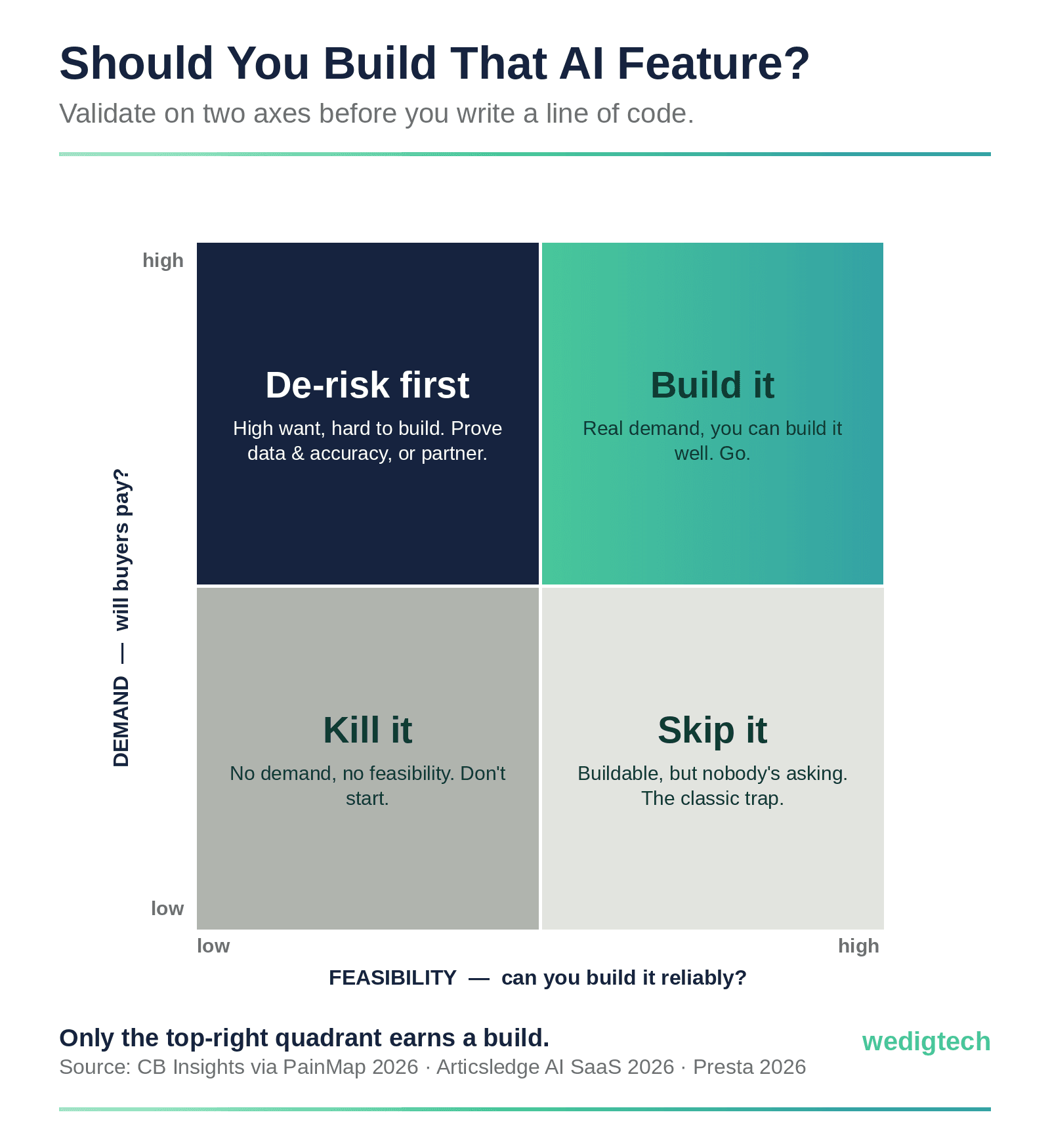
Plot the feature on demand and feasibility — only the top-right quadrant earns a build.
The Pre-Build AI Feature Validation Checklist
Run the feature through these seven gates before you commit engineering time. For each, do the test, check the result against the pass bar, and if it fails, take the action in the last column instead of building. A feature has to clear all seven to earn a build.
Validation gate | How to test it | Pass bar | If it fails |
Demand | 20–50 buyer interviews; a smoke-test landing page driving 200–500 visitors | 5–10% sign up; the pain is named unprompted | Don't build — the pain isn't real enough |
Willingness to pay | Proof of wallet: an LOI, a paid pilot, or what they pay for adjacent tools | At least one written commitment or pre-sale | It's a nice-to-have, not a paid feature |
Differentiation | Ask how they solve it today; map the current workaround | Clearly beats the status quo, not marginally | Not worth building over their workaround |
Data feasibility | Confirm you can access enough quality data to make it work | Sufficient, accessible, permitted data exists | De-risk data first, or partner |
Accuracy bar | Define the accuracy buyers need vs. what's achievable (prompt-eng gets ~90%) | Achievable accuracy meets the tolerance | Scope down, or don't ship it as AI |
Unit economics | Estimate inference cost per use against the price it commands | Margin holds at expected usage | Reprice, cap usage, or shelve it |
Product fit | Confirm it fits an existing workflow and has an owner | Slots into a real workflow, not bolted on | Rethink where it lives |
The two gates founders skip most are the AI-specific ones — data feasibility and unit economics — and they are the ones that sink AI features specifically. Most AI SaaS features reach about 90% of the desired behaviour through prompt engineering on existing models, so custom model work is rarely the first move, according to Articsledge (2026). Validate what accuracy the use case actually needs before assuming you need to build anything heavy: content generation tolerates 85–90%, but a feature buyers rely on for decisions may need far more.
Validate in Days, Not Quarters
The reason to do this is that validation is now radically cheaper than building. Traditional validation once took three to six months and $5,000 to $50,000; today the demand and feasibility checks compress into days, according to Ideas With Wings (2026). A smoke-test landing page, twenty customer conversations, and a data-access check cost a fraction of a build — and they tell you which quadrant the feature is really in before you spend the quarter.
The discipline is simple to state and hard to follow: define what a pass looks like before you look for evidence, and be willing to kill your own idea. The AI feature worth building is the one that survives all seven gates — real demand, proven willingness to pay, a clear edge over the workaround, accessible data, an achievable accuracy bar, economics that hold, and a home in the product. Everything else gets validated further, parked, or killed before it costs you a quarter.
From Validation to a Built AI Product
Validation tells you what to build. The harder question comes next: once a feature clears all seven gates — especially the two that landed it in the 'de-risk first' quadrant, data and accuracy — how do you actually build it well without a full in-house AI team? That is where most validated AI features stall a second time.
Wedigtech partners with B2B SaaS companies on exactly that — AI product innovation. Once a feature is validated, Wedigtech co-builds it: bringing the AI talent, the data and model work, and the infrastructure to ship it reliably, so a validated idea becomes a shipped, working feature rather than a backlog item waiting on a hire you have not made.
Was this helpful?
Ready to architect your next stage of growth?
Partner with wedigtech and turn ambition into compounding, measurable outcomes.
More from Insights
View All

How to Find a Technology Partner for Your Mobile App Development in 2026
How to find a technology partner for mobile app development in 2026: the green flags to look for, the red flags to avoid, the exact process to shortlist and vet one, and the questions to ask.
Read More
Build, Buy, or Partner: How Should You Ship Your First AI Feature?
Build, buy, or partner for your first AI feature? A simple framework for B2B SaaS teams: when each path fits, the questions that decide it, and the mistakes to avoid.
Read More
How to Build an AI Business in 2026: The Founder's Blueprint
A founder's guide to building an AI business in 2026: the six-step blueprint, what AI-native really means, the traps to avoid, and how to start — from finding the right problem to building a data moat.
Read More