Aug 25, 2026
![Which System Fails First as You Scale? [B2B SaaS - 2026 Audit]](/_next/image?url=https%3A%2F%2Fwedigtech-strapi-media.s3.ap-south-1.amazonaws.com%2Ffiles%2FWedigtech_Blog_Images_bc4d4315d4.png&w=3840&q=75)
Which System Fails First as You Scale? [B2B SaaS - 2026 Audit]
Something Always Breaks First. The Question Is What.
Every founder who has scaled a business knows the feeling: things are working, revenue is climbing, and then something snaps. Delivery quality slips. The pipeline dries up. A process that ran fine for two years suddenly produces errors nobody can explain. Growth exposes the weakest system in the business, and it always exposes one before the others.
The direct answer to the question is this: the part of your business that breaks next is the system carrying the most manual load at your current revenue stage. As you scale, volume rises faster than your systems were built to handle. Whichever system is held together by a person, a spreadsheet, or the founder's memory is the one that fails first.
The good news is that this is predictable. You do not have to wait for the break to find out where it is. You can audit for it now.
Why Scaling Breaks Businesses That Have Already Won
This is not a rare problem. McKinsey analysed 3,164 venture-backed companies and found that 78% of businesses that reach product-market fit still fail to scale, as reported by Ops Harmony (2026). The reason is not product quality or market demand. It is that every revenue threshold demands a different operating system, and most founders keep running the old one until something breaks.
The cost of finding out too late is steep. The U.S. Bureau of Labor Statistics reports that 49.4% of new businesses close within five years, and for companies past the startup stage the failure is usually not about the market. It is about internal systems failing to keep pace with growth. A business growth plateau, as Strategy & Execution (2026) puts it, occurs the exact moment operational complexity outpaces leadership capacity.
The pattern is consistent enough to plan around. Each of the four core business systems tends to break at a predictable stage — and the earlier you see which one is closest to its limit, the cheaper it is to reinforce.
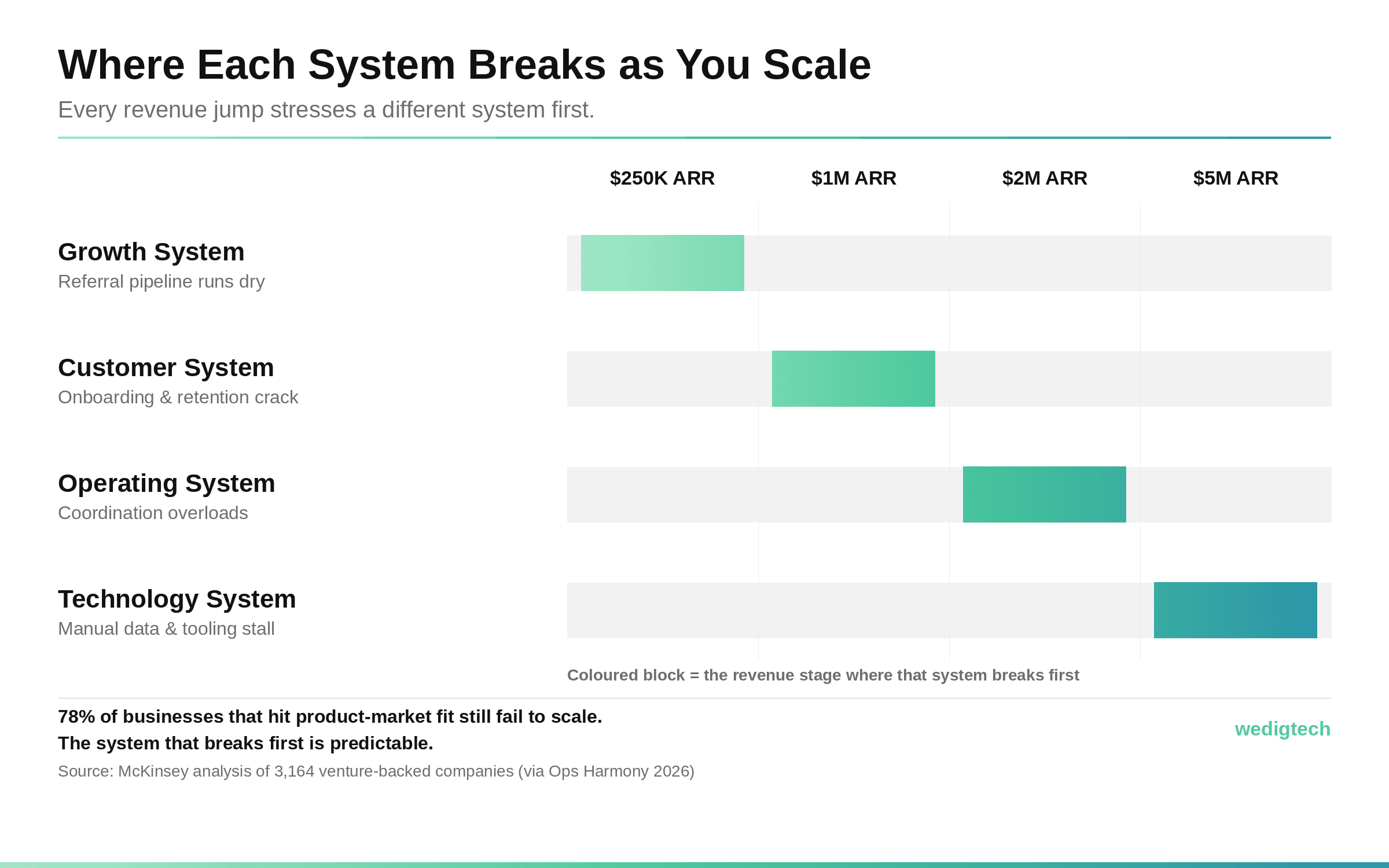
Every revenue jump stresses a different system first. The system that breaks is predictable.
The Four-System Scaling-Gap Audit
Score your business on each of the four systems below. For each one, mark whether it is Solid, Straining, or Breaking based on the described symptoms. The system you mark closest to Breaking is your next failure point — and your highest-priority fix.
System 1 — Growth
Signal | Solid | Straining | Breaking |
Pipeline source | Systematised, multi-channel | Mostly referral, some outbound | Entirely referral and founder network |
Founder's role in sales | Occasional, strategic | In most deals | In every deal, and it's the ceiling |
Predictability | Forecast within 10% | Rough visibility | No idea what next quarter looks like |
System 2 — Customer
Signal | Solid | Straining | Breaking |
Onboarding | Systematised, consistent | Works but people-dependent | Different every time, quality varies |
Retention visibility | Churn signals surfaced early | Reviewed occasionally | Discover churn at cancellation |
Expansion revenue | Systematic, tracked | Ad hoc when noticed | Not happening — all new logos |
System 3 — Operating
Signal | Solid | Straining | Breaking |
Coordination | SOPs run without founder | Some process, gaps remain | Everything routes through founder |
Decision speed | Delegated with clear authority | Slows at the top | Nothing moves without founder sign-off |
Visibility | Live dashboards, automated | Manual weekly assembly | Assembled reactively when something's wrong |
System 4 — Technology
Signal | Solid | Straining | Breaking |
Data | Unified, one source of truth | A few disconnected systems | Spreadsheets and manual reconciliation |
Delivery / output | Automated where possible | Partly manual | Manual, slow, error-prone at volume |
Tooling scales | Grows with the business | Straining at current volume | Already the bottleneck |
Read the results simply. The system with the most Breaking marks is what fails next. If two are tied, the one earlier in the sequence — Growth, then Customer, then Operating, then Technology — usually breaks first, because each feeds the next. A business that cannot fill its pipeline never stresses its delivery capacity.
Where AI Turns an Audit Into an Early-Warning System
A manual audit tells you where you stand today. It cannot tell you the moment a system tips from Straining to Breaking — for that, you would have to re-run the audit constantly, which no founder does. This is where AI signal detection changes the picture.
The distinction is the same one that separates a report from an alarm. Most business dashboards are built to describe what already happened. AI operational intelligence is built to flag what is about to happen.
The gap is measurable. Operations that depend on manual reviews and end-of-period reports to detect a forming bottleneck typically lose hours — sometimes days — before the constraint is even identified, according to operational intelligence research from Aerospike citing Gartner (2025). An AI layer shrinks that detection gap toward real time, flagging emerging restrictions based on patterns invisible to manual observation.
Applied to the four systems, AI signal detection works in a defined sequence — identify, diagnose, predict, prescribe.
Identify and diagnose. The system reads operational data across all four areas continuously and pinpoints not just that a metric moved, but the root cause — a coordination delay, a retention dip in a specific cohort, a data pipeline slowing down.
Predict. This is the part a manual audit cannot do. By reading patterns across systems, an AI layer anticipates which system will hit its limit next, and roughly when — turning 'something will break' into 'the Operating System will break in about six weeks at current growth.'
The reliability of this depends entirely on one thing: connected data. 2026 manufacturing AI research (via Backwell Tech, citing McKinsey State of AI 2025) found that 73% of organisations say data is where their AI efforts most commonly stall, and companies that buy an AI tool before defining the specific problem are three times more likely to stall on unclear use cases. The intelligence layer only works when it sits on a connected operating foundation — which is why the sequence is foundation first, intelligence second.
What Early Detection Is Worth
The value of seeing the break before it happens is concrete. In 2025, 72% of C-suite executives reported that AI-powered process mining — which builds a live model of how work actually flows through ERP and CRM systems — improved both efficiency and cost management, according to HRBrain (2026). One documented deployment cut proposal generation time from five-to-seven days to 24 hours by surfacing the exact bottleneck in the workflow.
The founder who audits the four systems today knows where the weakness is. The founder who has an AI signal layer on top of a connected operating system knows when it will break, and fixes it while it is cheap to fix. That is the difference between reacting to a broken system and reinforcing one before it fails.
From a One-Time Audit to a System That Watches Itself
The audit above is a snapshot. It tells you which of your four systems is closest to breaking right now, and that alone is worth more than most founders have. But a snapshot ages. The real goal is an operating system that monitors its own health — that surfaces the strain before it becomes a break, across Growth, Customer, Operations, and Technology at once.
Wedigtech's Operating System is built to install exactly that. It connects the operational data you already generate into one foundation, then adds the AI signal layer that reads all four systems continuously and flags the next constraint before it forms. Because Wedigtech takes equity in the outcome, the system is built to keep compounding after Month 6 — an operating layer that gets sharper as it accumulates data, not one that goes stale the moment the engagement ends.
Was this helpful?
Ready to architect your next stage of growth?
Partner with wedigtech and turn ambition into compounding, measurable outcomes.
More from Insights
View All

100+ AI Tools for Services Businesses (Organized by Use)
A categorised directory of 100+ AI tools for services businesses — for proposals, CRM, scheduling, delivery, support, finance, marketing and more — with what each one is best for.
Read More
Build AI Products and Operations Without Fronting the Cost: The Wedigtech Model
Most businesses fund 100% of their technology upfront and carry all the risk. Wedigtech's co-investment model is different: you invest ~30%, Wedigtech invests ~70%, and economics align to the value created.
Read More
The Best AI Tools to Automate B2B SaaS RevOps in 2026
The best AI tools to automate B2B SaaS RevOps in 2026 — the full stack by layer, from CRM and enrichment to forecasting and automation, with what AI does in each and where to start.
Read More