Aug 25, 2026

The D2C Tech Budget Audit: Compounding vs Draining Spend
The Budget Grows. The Capability Doesn't.
Every year the technology line on the budget gets bigger. More tools, more subscriptions, more infrastructure, more people to keep it all running. And every year the founder asks the same quiet question: we are spending more than ever on technology — so why doesn't it feel like we can do more than we could last year?
The answer is not that you are overspending. It is that most of the spend is going somewhere that does not build anything. There is a difference between technology spend that compounds — that builds capability which appreciates over time — and technology spend that drains — that maintains what already exists and depreciates the moment you stop paying for it. Most budgets are overwhelmingly the second kind.
The direct answer to where your budget is going: roughly 70% of it is keeping the lights on, and only about 30% is building anything new. Here is how to see the split in your own numbers, and how to shift it.
The 70% Problem
The pattern is consistent enough to have a name. The 70/20/10 rule — a widely used IT budgeting benchmark — allocates roughly 70% of the technology budget to operations and maintenance, 20% to enhancing existing systems, and 10% to innovation and new initiatives, according to Ramp's 2026 IT budgeting guidance. Across industries, nearly 70% of IT budgets are absorbed by maintenance and operations — infrastructure upkeep, security patching, support, and compliance, according to Synoptek's analysis of the '70% problem' (2026). Deloitte research has put the maintenance share as high as 56% on legacy systems alone.
That maintenance spend is not optional — the lights genuinely need to stay on. But it does not compound. And when it grows unchecked, it eats the budget that would. As Velocity-Smart's 2026 CFO IT budget guide puts it, when 'run' spending creeps above 70%, the organisation is consuming its growth and transformation budget on maintenance — a signal to act before asking for more money.
Meanwhile, a large share of the draining spend is pure waste. Organisations waste an average of 30% of their SaaS spend on unused or underutilised licences, according to Velocity-Smart (2026). That is budget leaving the business every month and building nothing on the way out.
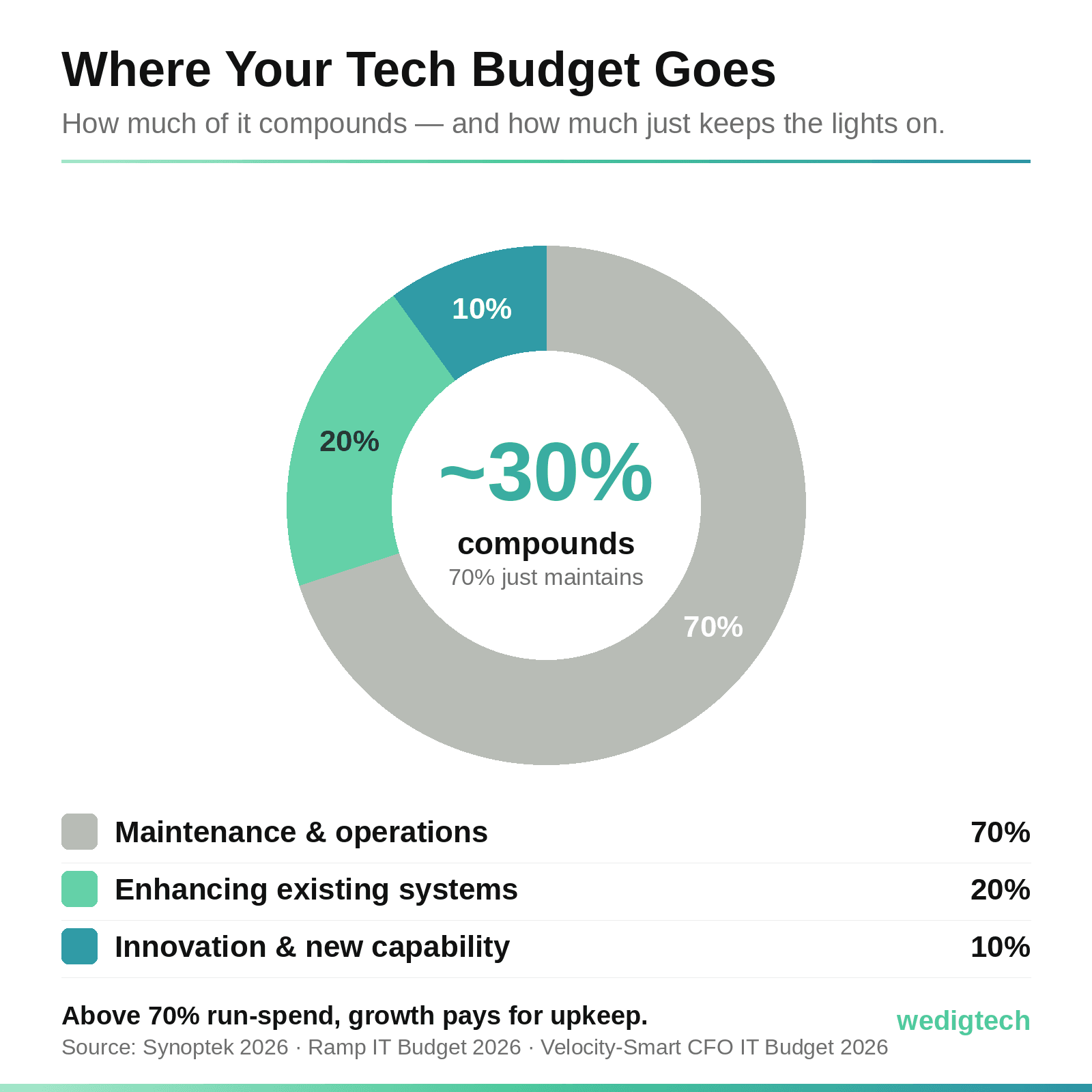
The typical technology budget — only about 30% builds capability that compounds.
The Compounding vs Draining Tech Spend Audit
Pull your technology spend and sort every line item into one of two buckets. Does this cost build capability that keeps paying off after you stop spending on it — or does it maintain something that stops the moment the payment does? Compounding spend appreciates. Draining spend depreciates. Here is how the common categories sort, with the benchmark to check yourself against.
Technology cost | Bucket | Why | Healthy benchmark |
Infrastructure upkeep, hosting, patching | Draining | Maintains what exists; stops when you stop paying | Part of the ≤60–70% 'run' budget |
Tool & SaaS licences (esp. underused) | Draining | Recurring cost, no lasting asset; ~30% is waste | Audit quarterly; reclaim unused seats |
Integration upkeep & fixing breakage | Draining | Effort to stand still; grows with a fragmented stack | Should shrink as systems consolidate |
Manual workarounds & patches | Draining | Human time filling system gaps; scales with volume | A signal to invest in the system, not the patch |
Systems that automate a manual function | Compounding | Capability that keeps working and improving | Grow this — target 30–40% 'change' spend |
Data & intelligence infrastructure | Compounding | Appreciates as data accumulates | Foundational; fund before feature tools |
New capability that opens revenue | Compounding | Builds an asset the business didn't have | The 10% innovation slice — protect it |
Tally each bucket. If your compounding spend is below 30%, you are in the same trap as most growth-stage businesses — the budget is rising, but it is rising in the draining bucket. And the tell is exactly the symptom you started with: spend goes up, capability stays flat. High performers do the opposite — they allocate nearly half of their innovation budgets to revenue-generating initiatives, while low performers spend most on maintenance, according to FounderNest's 2026 innovation benchmarks.
Where AI Shifts the Ratio — For Better or Worse
AI is the biggest lever on this ratio in either direction, and which way it moves depends entirely on how it is deployed.
Deployed badly, AI makes the 70% problem worse. A pile of disconnected AI subscriptions, each needing its own upkeep and none connected to the others, is just more draining spend wearing a more expensive badge. It adds to run, not change.
Deployed well, AI does the one thing that actually shifts the ratio: it automates the manual work sitting inside the draining bucket, freeing that budget to move to the compounding one. Enterprises are explicitly funding this shift — reinvesting the savings from cost optimisation and AI-driven productivity into transformation, with AI spending rising far faster than overall IT budgets, according to ISG's enterprise study. The move is not 'spend more on technology.' It is 'move spend from the bucket that drains to the bucket that compounds.'
That only works when the AI is built as connected system rather than scattered tools — when automating a manual function actually retires the manual cost instead of adding a new one on top. The ratio shifts when the draining line goes down, not when the innovation line goes up alone.
What Fixing the Ratio Is Worth
The prize is not a smaller technology budget. It is the same budget building far more. Moving even ten points of spend from draining to compounding — from maintenance and licence waste into systems that automate and data that appreciates — changes what the business can do next year without changing what it spends this year. A business spending 30% on capability compounds; a business spending 10% treads water while paying more to do it.
The businesses that pull ahead are not the ones with the biggest technology budgets. They are the ones whose budgets are pointed at things that keep paying off after the spending stops.
From a Draining Budget to a Compounding System
Seeing the split is the first step. Shifting it is a systems problem — consolidating the fragmented stack that creates the integration upkeep, automating the manual work that drives the workaround cost, and building the data foundation that makes every future investment compound instead of start from scratch. Most of the draining spend exists because the underlying systems were never designed to work as one.
Wedigtech's Technology System is built to redesign exactly that — auditing where the budget drains, consolidating and automating the run costs, and rebuilding the foundation so that a rising technology spend translates into rising capability rather than rising maintenance. Because Wedigtech takes equity in the outcome, the incentive is a budget that compounds after Month 6 — technology spend that appreciates as an asset, not one that has to be renewed every year just to stand still.
Was this helpful?
Ready to architect your next stage of growth?
Partner with wedigtech and turn ambition into compounding, measurable outcomes.
More from Insights
View All

20 AI Agents for a Founder's Daily Department Reporting
20 AI agents that report a founder's daily numbers from every department: sales, marketing, finance, product, support, operations and people, rolled into one morning brief.
Read More
Your Second COO Is AI: How D2C Brands Run Operations on Autopilot
Every D2C founder is secretly the COO — running inventory, support, fulfilment and reporting in the gaps. Here's how AI becomes your second COO: watching the business 24/7, flagging problems early, and running the operational busywork.
Read More
100+ AI Tools for Services Businesses (Organized by Use)
A categorised directory of 100+ AI tools for services businesses — for proposals, CRM, scheduling, delivery, support, finance, marketing and more — with what each one is best for.
Read More