Aug 9, 2026

Build AI Products Without Fronting the Cost: The Wedigtech Model
The AI Product Is the Easy Part. The Upfront Bet Isn't.
Most enterprises do not lack AI product ideas. They lack a way to build them that does not require betting a fortune upfront on an outcome nobody can guarantee. The idea is clear; the path to it runs through a wall of upfront cost, specialist hiring, infrastructure, and risk — and that wall is where most AI ambitions quietly stop.
The reason is simple economics. Innovating a real AI product is not a software project with a fixed price and a predictable return. It is a large, front-loaded investment with a genuinely poor success rate — which makes it exactly the kind of bet a disciplined enterprise is right to hesitate over.
There is another way to do it, and it changes the economics entirely: instead of the enterprise carrying the upfront cost and the risk alone, a partner carries them alongside — aligned to the outcome, not to an invoice. That is what Wedigtech's AI Capability Partnership is built to do. Here is the problem it solves, and how it works.
What Building an AI Product Actually Costs — and Why Most Fail
The upfront number is larger than most teams expect. A custom enterprise AI platform typically costs $300,000 to $1.5 million or more upfront, plus another 20 to 30% of that figure every year for compute, retraining, and monitoring, according to Kellton's 2026 enterprise AI development research. And that is before the team: AI specialists command $150,000 to $300,000 each annually, and a six-person AI team runs $1.2 million to $2.5 million a year fully loaded, according to Uvik's 2026 AI development cost analysis.
The odds on that spend are the harder part. More than 80% of enterprise AI projects fail to deliver their intended business value, according to RAND research confirmed by Gartner (April 2026). Cost overruns at production scale average 380% over pilot budgets, and most AI budgets are wrong by two to four times before development even begins (Uvik 2026). In 2025, 42% of companies scrapped most of their AI initiatives, according to Value Add VC (2026).
Put those two facts together and the enterprise hesitation makes complete sense. You are being asked to commit seven figures upfront, and eight in ten similar efforts do not pay off. No amount of enthusiasm for AI makes that an easy bet to sign off. The problem was never the ambition. It was the structure of the investment.
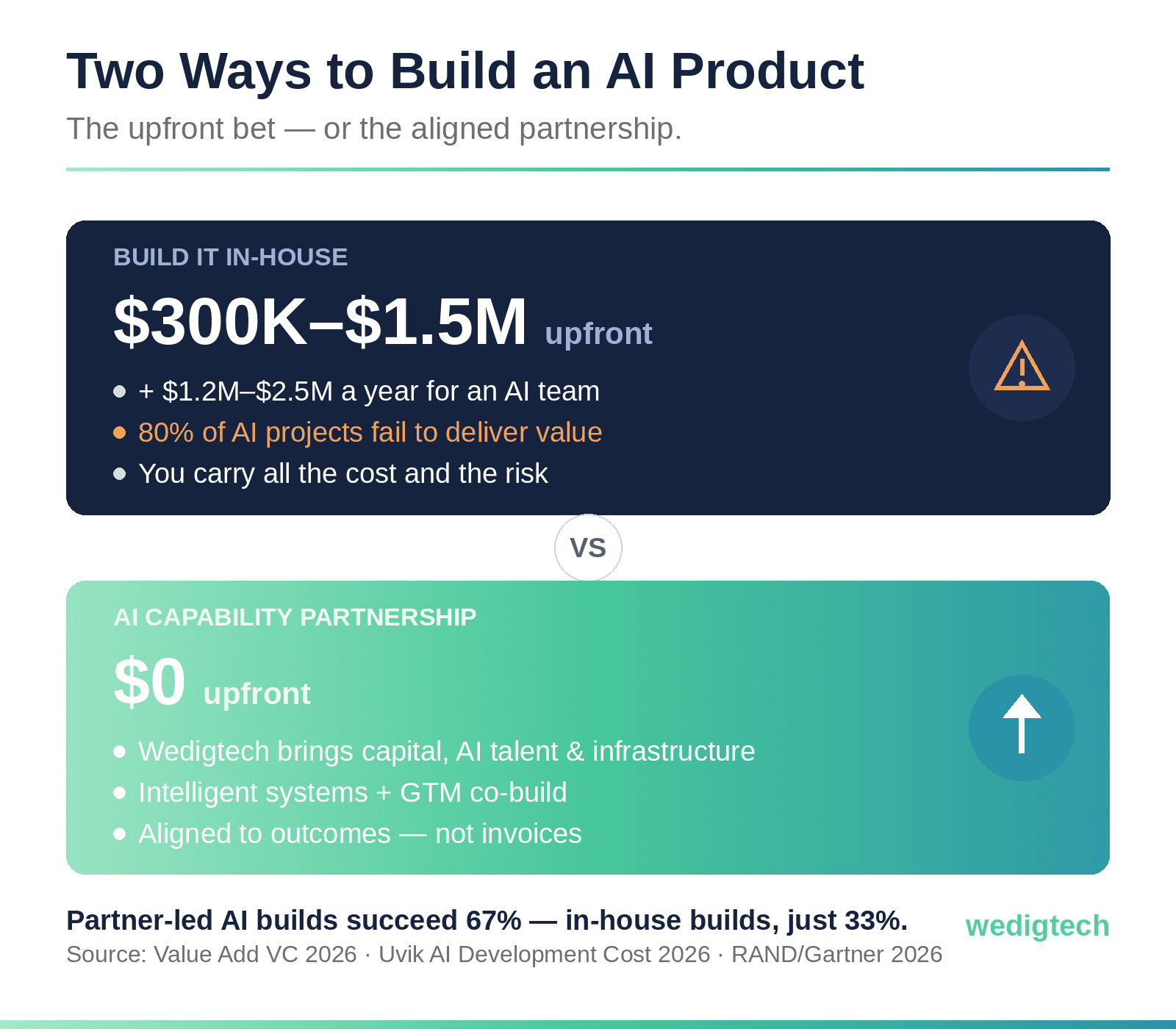
Two ways to build an AI product — the upfront bet, or the aligned partnership.
How the AI Capability Partnership Removes the Upfront Cost
The AI Capability Partnership changes one thing that changes everything: who fronts the cost and carries the risk. Rather than the enterprise assembling the capital, the team, and the infrastructure before a single validated result exists, Wedigtech brings that capability to the table and is paid through the outcome it helps create.
In practice, Wedigtech contributes the pieces that make the upfront bill so large in the first place: the capital, the AI talent, the infrastructure, the intelligent systems that connect it all, and the go-to-market build to turn the product into revenue. The enterprise contributes what only it has — the domain, the data, the market access, and the problem worth solving. The two build the product together.
And critically, the commercial model is aligned to results. Instead of large upfront fees, the partnership is structured around outcomes and an equity stake — Wedigtech is paid as the product works, not before it does. That single structural change moves the AI product from a capital-expenditure bet the enterprise makes alone into a shared build where the partner only wins when the enterprise does.
Why an Aligned Partnership Beats Building Alone
This is not just a financing preference — the outcomes differ. Partner-led AI builds succeed roughly 67% of the time, versus about 33% for pure in-house builds, according to Value Add VC's 2026 analysis of enterprise AI budgets. The gap comes from exactly what a good partner brings: the talent, the pattern-recognition from having built before, and the discipline of scoping to a real business outcome — the single largest predictor of AI success, since projects with quantified success metrics defined upfront hit a 54% success rate versus 12% without (Gartner, April 2026).
Equity alignment sharpens all of it. When a partner's return depends on the product actually working and continuing to work, the incentive is not to bill hours or ship a deliverable and leave — it is to build something that compounds. That is the difference between a vendor, who is paid to complete a project, and a partner, who is paid when the outcome lands. Wedigtech is built as the second kind. Its engagements treat Month 6 as the floor, not the finish line — the point at which the system should be compounding, not the point at which support ends.
The Track Record Behind the Model
A partnership model that puts capital and capability at risk only works when the partner can actually deliver the outcome. Wedigtech brings 15+ years of building intelligent systems, more than 100 enterprise partnerships, and over $200M in influenced revenue across more than 10 industries — the track record that makes shared-risk, outcome-based engagements viable rather than aspirational.
That experience is what lets Wedigtech underwrite the upfront cost an enterprise would otherwise carry alone. It is not a leap of faith on either side — it is a partner with a proven ability to build AI products that work, choosing to be paid for exactly that.
Innovate on AI Without the Upfront Bet
The enterprises pulling ahead on AI in 2026 are not necessarily the ones with the biggest budgets to gamble. They are the ones who found a way to innovate without making the whole bet themselves — sharing the cost, the capability, and the risk with a partner aligned to the same outcome. That is the entire premise of the AI Capability Partnership: the AI product gets built, the upfront cost comes off the enterprise's shoulders, and the partner only wins when the product does.
Book a call
If your enterprise has an AI product worth building but not the appetite to carry the upfront cost and risk alone, it is worth a conversation. Book a 30-minute discovery call to explore whether an AI Capability Partnership fits — what you would bring, what Wedigtech would fund and build, and how an outcome-aligned model would work for your product.
Was this helpful?
Ready to architect your next stage of growth?
Partner with wedigtech and turn ambition into compounding, measurable outcomes.
More from Insights
View All
The Shift From Project Management Tools to Intelligent Systems
In 2026 project management shifts from tools that track work to intelligent systems that run it. Here's what changes, and how to tell where your setup stands.
Read More
The D2C Tech Budget Audit: Compounding vs Draining Spend
Most tech budgets spend 70% keeping the lights on and only ~30% building capability that compounds. Here's how to see the split — and shift it.
Read More
Reclaim 20+ Hours a Week: The D2C AI Operations Playbook
D2C founders lose 20+ hours a week to tasks AI can run today. Here's the operations audit that shows where the time goes — and how AI-led operations give it back.
Read More